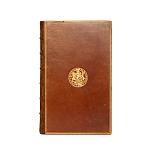
Nepos, Cornelius: (Van Staveren, Augustinus, ed:) Vitae Excellentium Imperatorum, cum notis selectis Boecleri, Bosii, Buchneri, Ernstii, Gerhardi, Heidmanni, Lambini, Loccenii, Longolii, Magii, Ravii, Savaronis, Schefferi, Schotti, nec non excerptis P. Danielis. Hisce accedit locupletissimus omnium vocabulorum index studio & opera Lugduni Batavorum [Leiden]: Apud Sam. et Joan. Luchtmans, 1773 [1774]. 2nd ed., expanded. 8vo., pp.[32], 832, [176]. Additional engraved title-page dated 1774, woodcut initials, head- and tail-pieces, engraved illustrations in the text (portraits). A few pencil marks, eg. p.117. Contemporary vellum prize binding, gilt spine, borders, corner tools and centrepiece coat of arms of Utrecht to each board, edges sprinkled red and blue. A few light marks, ties lost, very good. Includes: C. Nepotis fragmenta [?] A. Schotti studio collecta, scholiisque illustrata [?] recensita [?] et [?] aucta a J.A. Bosio, cujus [?] animadversiones Schottisnis interseruntur, Curante A. van Staveren. With index at rear. Dibdin II, p246 for this, the better of two Staveren editions (1734 and 1773); Schweiger II pt.i, 302. Ref: 54555show full image..
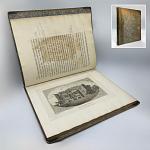
Newcourt, Richard: Repertorium Ecclesiasticum Parochiale Londinense: An Ecclesiastical Parochial History of the Diocese of London: Containing an Account of the Bishops of that Sea, from the first Foundation thereof: also, of the deans, archdeacons, dignitaries and prebendaries, from the Conquest: and lastly, of the se London: printed by Benj. Motte, and are to be sold by Chr. Bateman, Benj. Tooke, Ric. Parker, 1708; 1710. 2 vols., folio, pp.[iv], vii, [I], 761, 764-5, 768-9, 772-3, 776-928, [ii] (i.e. usual mispagination) + 4 plates; [viii], 692, [lii] + 2 plates. Vol. I with portrait frontispiece and errata leaf, vol. II with half-title and list of subscribers, as called for. Sporadic toning, vol. II heavily toned from p.609 onwards and with a small worm trail near gutter for approx. first hundred pages. MS to ffep vol. I (a description in heraldic terminology of the arms of Richard Newport depicted on the frontispiece). Contemporary Cambridge panelled calf, raised bands and reddish title labels to spines, edges sprinkled red. A bit worn with some scrapes, but very good. Each volume with armorial bookplates of John Hoadly, LLD to front paste-down and Henry Carrington Bowles to rear paste-down (the latter being the Bowles arms with those of H.C.B.'s wife Ann Garnault inset). Historian and notary Richard Newport (d.1716) complied this history of the Diocese of London from sources including the London Registers (begun in 1306), registers kept by individual bishops and a return of 1636 from which he took information about the income of the parishes. His father (also Richard Newcourt, d. 1679) was a cartographer and draughtsman who, in addition to contributing drawings to Dugdale's Monasticon, was also responsible for the most important map made of London before the Great Fire, his Exact Delineation of the Cities of London and Westminster and the Suburbs Thereof (1658). John Hoadly (1711-1776) was a poet and dramatist, and a friend and correspondent of David Garrick. The appearance of 'LLD' on his bookplate dates it from sometime after 1747. Henry Carrington Bowles (1763-1830) was a successful publisher and seller of maps, prints and geographical games. His bookplate dates from sometime after his marriage in 1799. The ephemera found between the pages of vol. I appears to relate to his ownership of the book. Loosely inserted: two letterpress-printed sheets reproducing letters sent in January 1824 and February 1827 to The Gentleman's Magazine, concerning London churches destroyed in the Great Fire of 1666 (both from 'H.C.B.'); small hand-drawn and coloured arms of Sir John Philpot, Lord Mayor of London 1378, on a scrap of paper; a piece of tracing paper with a coat of arms and an inscription referring to Sarah Bolles; 4 scraps of paper with MS notes, one seemingly part of a letter addressed to H.C. Bowles Esq. and dated 1827; a long MS list of churches on a folded piece of paper watermarked 1821. ESTC T5439; Upcott 690; Lowndes 1665; Graesse IV 662. Ref: 54146show full image..
Nieupoort, G.H.: (Nagel, Carel Ferdinand, ed,:) Rituum, qui olim apud Romanos obtinuerunt, succincta explicatio; ad intelligentiam veterum auctorum facile methodo conscripta [...]. Lugduni Batavorum [Leiden]: [s.n.], 1802. 8vo., pp. viii, 614, [ii] + additional engraved title + 11 plates, 10 of which folding. With half-title, a few pages unopened at fore-edge. Occasional very faint spotting, some light toning, light damp staining at fore-edge increasing towards rear and becoming pinkish. Contemporary vellum prize binding with certificate bound in, spine gilt, gilt arms of Utrecht centrepiece to each board surrounded by border and corner tools, edges sprinkled red and blue. Spine a little darkened, a few small marks, all ties bar one lost, very good indeed. An illustrated study of Roman rituals. Scarce in the British Isles, COPAC locates copies in the British Library and the Bodleian only. Spoelder 4. Ref: 54430show full image..
Oliver, William: A Practical Essay on the Use and Abuse of Warm Bathing in Gouty Cases. Bath: Printed by T. Boddely, for James Leake, and Wm. Frederick, and sold by Hitch, and Hawes, and M 1753. Second edition. 8vo., pp. [iv], 96, [viii]. With half title. Some small repairs and short marginal tears to half title, first and last leaves a little dusty. Late 19th c. Half dark brown morocco, gilt title to spine, green marbled paper boards, blue endpapers. Joints and corners a bit rubbed, very good. Bookplate (with crest) of John Kent Spender, M.D. to front pastedown. Though by all accounts an engaging and competent physician, and very much involved in establishing Bath General Hospital in 1742, Dr William Oliver published little apart from this treatise on the therapeutic use of spa waters in the treatment of gout. However his name lives on in the form of the Bath Oliver biscuit, which he invented as a digestive aid for his patients. John Kent Spender's obituary (BMJ, 22nd April 1916) described him as 'The last of the generation of physicians who laid the foundation of modern Bath as a health resort.' He worked for the greater part of his career at the Mineral Water Hospital in Bath and published prolifically, his most notable book being Therapeutic Means for the Relief of Pain, which won the Fothergill Gold Medal in 1874. Ref: 54177show full image..
Optatus; (Du Pin, Louis Ellies, ed.:) Sancti Optati Afri Milevitani episcopi De schismate Donatistarum, libri septem [?] [...] Lutetiae Parisiorum [Paris]: apud Andream Pralard, 1700. First edition thus. Folio, pp.[xxii], civ, 601, [I] + large folding map. Half-title, title-page in red and black with engraved device, finely engraved head- and tail-pieces, ornate initials, errata to final leaf verso. Remarkably the map appears never to have been bound in, and is loosely inserted opposite p.1. A few fragments of blue paper stuck to half-title near gutter, a few leaves lightly toned with faint foxing eg. pp.45-51, occasional light spotting, very faint damp staining to a few leaves near gutter, a few leaves with slight paper flaws to fore-edge margins, overall very good. Slightly later half sheep with brown paper-covered boards, red morocco label to spine, all edges red, marbled endpapers. Spine very worn, hinges split but cords holding firm, boards rubbed with some loss of colour, corners worn and frayed, a few pencilled bookseller's notes to ffep verso. Still a good, sound copy. Tiny paper label to top corner of front paste-down: J. Mosley Stark, 10 King William Street, London. Tiny paper label to top corner ffep verso: sold by C.J. Stewart, 11 King William Street, London. To the title-page, round blue ink stamp of St Hugh's, Parkminster. Celebrated edition of this contemporary history of the 4th-cent. north African Donatist heresy, the editor inserts other material relevant to north African and Donatist history and geography. His recension of the text was used later by Migne in his 'Patrologia Latina'. Graesse V 30: "C'est la meilleure ?d. faite sur 5 mss." Ref: 54563show full image..
[Paris, Matthew:] (Parker, Matthew, ed.:) Flores Historiarum per Matthaeum Westmonasteriensem collecti, praecipue de rebus Britannicis ab exordio mundi usque ad annum Domini. MCCCVII. Francofurti [Frankfurt]: Typis Wechelianis, 1601. Folio, pp. [viii] 696 [xxiv]. Printer's device to title-page and to final leaf verso, ornate woodcut endpieces and initials. Faint blotchy foxing, some leaves toned, occasional tiny wax spots, a few very discreet paper repairs. Later (approx. 1821-1860) tan calf binding by Clarke & Bedford of Frith Street (their ink stamp to upper corner ffep, verso), spine richly gilt with raised bands; gilt centrepiece, borders and dentelles to each board, a.e.g., marbled endpapers. Joints slightly creased, a little wear to endcaps but very good indeed. Centrepiece gilt arms of John Frederick Campbell, 1st Earl Cawdor (1790-1860). Campbell married in 1816 and succeeded his father in 1821, and these arms appear to postdate both of those events. Campbell was a Fellow of the Royal Society, MP for Carmarthen (1813-1821) and Lord Lieutenant of Carmarthenshire (1817-1860). Ownership inscription of J. Campbell in an old hand to blank leaf preceding title-page. A reprint of the second edition (London, 1570) of Matthew Paris's important historical chronicle (formerly attributed to the fictional 'Matthew of Westminster'), as edited by Matthew Parker. The text covering the period to 1259 is based on the author's Chronica Majora; the 1259-1307 text was compiled and composed by various writers at St. Albans and Westminster; the text from 1307 to 1325 is by Robert of Reading. Includes the chronicle based on the work of Marianus previously attributed to Florence of Worcester, now attributed to John of Worcester. Ref: 54533show full image..
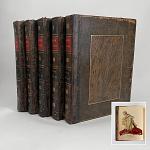
[Paston letters] (Fenn, John, ed.:) (Frere, Serjeant:) Original Letters, written during the Reigns of Henry VI, Edward IV, and Richard III, by various Persons of Rank or Consequence [...] with Notes, Historical and Explanatory; and Authenticated by Engravings of Autographs, Fac Similes, Paper-Marks and Seals. London: printed for G.G.J. and J. Robinson, 1787, 1789, 1823. 5 vols., extra-illustrated. Vols. I-II second editions with additions and corrections, vols. III-V first editions. 4to., pp. lxxxvii, [i], 301, [i]; [iv], 363, [i]; [iv], xvi, xxxvi, 451, [i]; [vi], xxxii, 478, [ii]; lxxvi, 472 + additional engraved vignette title and coloured engraved frontispiece to each vol. + 34 facsimile plates + 34 further plates. Extra illustrated with additional coloured engraved plates (landscapes etc), including folding map of England and Wales. With half-titles. Parallel medieval and modern texts. Vol. I preliminary blanks, title and pages facing tissue guards toned; small closed tear to map, occasional foxing, a few ink spots. Vol. II occasional foxing and toning, some neat pencil notes. Vol. IV, Some leaves a little toned, also some toning and light damp staining to plates. Some vols. bearing evidence of a bookplate having been removed. Contemporary calf panelled boards rebacked in mottled calf, spines gilt, raised bands, red and black spine labels, all edges faintly blue, marbled endpapers. A few chips to spine, board leather dry and rubbed, corners very worn, but good sound copies. To front paste-down each volume, crimson leather and gilt book label of W.A. Foyle of Beeleigh Abbey and ms inscription at head of ffep verso, Liverpool, Kirkham Abbey [illegible] 1907. Vol. I with pencilled note to front endpaper, 'Duke of York's copy'. John Fenn's edition of the Paston Letters was the first printing of this invaluable collection shedding light on the life of an aristocratic family (the Pastons, later Earls of Yarmouth) in the fifteenth century. The editor obtained the documents from the executors of a chemist in Diss, Norfolk, and later presented the originals for volumes I and II to George III, receiving a knighthood soon after. The work was nevertheless suspected for years to be a forgery, until the material (including what he had given to the King) resurfaced in various country houses in the later part of the nineteenth century. The fifth volume was sent to the press posthumously by Serjeant Frere, Fenn's nephew (Ency. Brit., 11th edn.) Lowndes 788: "Two editions of Vols. 1 & 2 were printed in 1787, but there is no perceptible difference between them." ESTC N010147 & T149304. Ref: 54569show full image..
Pennant, Thomas: A Tour from Alston-Moor to Harrowgate, and Brimham Crags. London: printed by C. Mercier and Co., Northumberland-Court, Strand, for John Scott, no.447, Strand, 1804. First edition. 4to., pp.[x], 130 + 9 plates as called for. Half-title. Title-page repaired at top fore-edge corner, some toning transferred from plates onto facing pages. Half green sheep, gilt title to spine, marbled paper boards, edges sprinkled brown, marbled paste-downs but free endpapers replaced with plain blue. Joints worn, boards quite toned, corners a bit frayed, still very good. Edited by Pennant's son David and published posthumously. 'Pennant's travels and natural history are distinguished by his personal energy, a keen observational sense, and by methodological organization and attention to facts. In such ways, and in his friendship and widespread correspondence with others of like interests throughout Britain and Europe, he may be said to exemplify those gentleman scholars of nature in the later eighteenth century whose interests in natural knowledge aimed at national improvement through intellectual enquiry. While he is perhaps better remembered for his Scottish tours, his British Zoology and Arctic Zoology in particular were important pioneering works and established him in the eyes of contemporaries as a leading European natural historian. For one modern scholar Pennant should be considered 'the leading British zoologist after Ray and before Darwin' (Beer, vi).' (Withers, ODNB) Ref: 54602show full image..
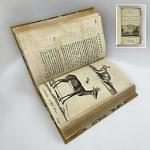
Pennant, Thomas: A Tour in Scotland; MDCCLXIX. Warrington: printed by W. Eyres, 1774. 1774. Third edition. 8vo., pp. viii, 316; viii, 172 + 18 plates to the first part and 21 plates to the second part. Additional engraved title-page with vignette dated 1774, followed by printed title-page dated 1771. Title-page to 'Additions to the 4to Edition [?]' dated 1774 after p.316. Some illustrations in the text. Occasional small ink spots, eider duck plate neatly repaired, 2G8 bottom corner of fore-edge margin lost not affecting text. Modern half calf olive green, raised bands and black gilt labels to spine, marbled boards, edges very lightly sprinkled blue, endpapers renewed. A little rubbed, a few light scuffs to spine, very good. To the second, printed title an ownership inscription possibly of C. Stuart (the end of the surname trimmed) dated 28th December 17(??). 'In 1769 Pennant undertook a tour of Scotland, chiefly of the highlands, a region then little known by outsiders yet of interest for its natural history. He again drew upon local specialist knowledge? men such as the Revd Dr John Walker, who had travelled extensively in the highlands and Hebrides in 1764 and 1766, and, in Aberdeen, the natural historian David Skene, who showed Pennant his cabinet of natural history and advised him on zoological and botanical specimens. Pennant's A Tour in Scotland, 1769, was published in 1771. It is of interest for its descriptions andfor its method: Pennant circulated 'Queries, addressed to the Gentlemen and Clergy of North-Britain' [Scotland] with standard questions about natural history and the past and present state of the parish in order to allow locals to give 'a fuller and more satisfactory Account of their Country, than it is the Power of a Stranger and transient Visitant to give' (Pennant, Tour in Scotland, 287). In that regard Pennant has much in common with the earlier use of circulated queries by natural philosophers such as Robert Boyle and, in Scotland, by the natural historian and geographer Sir Robert Sibbald, and Pennant importantly prefigures the parish-based assessment of Scotland published by Sir John Sinclair in the 1790s.' (Withers, ODNB) Ref: 54605show full image..
Pennant, Thomas: A Tour in Wales. London: printed for Benjamin White, 1784. Second edition. 2 vols., 4to., pp. [viii], 488, [viii] + 29 plates; ii, [ii], 487, [vii], [ix] + 35 plates. Engraved title-page with vignette to each vol., plus additional title-page 'The Journey to Snowdon' to vol. 2. Plates as called for, vol.I plates XXIV and XXV misbound. Dampstaining to vol. I front endpapers and title, occasional light toning. Contemporary green straight-grain Morocco, spines gilt, plain gilt borders and dentelles, a.e.g., marbled endpapers. Spines browned, joints a little rubbed, vol.I dampstained to lower half of each board, but good sound copies. Armorial bookplate to front paste-down each volume. Vol I.: A Tour in Wales. Vol. II. The Journey to Snowdon, plus Corrections and Additions to the first volume. Includes bibliographical references and indexes. Pennant (1726?1798) undertook several tours throughout Wales in the early 1770s where his Welsh-speaking friend, the Revd John Lloyd of Caerwys gave his assistance with translations. ESTC T213985 Ref: 54601show full image..