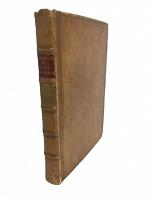
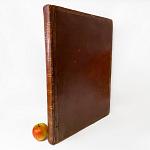
Pomponius Mela: (Gronovius, Abraham, ed.:) De Situ Orbis Libri III. Lugduni Batavorum [Leiden]: Ex Officina Samuelis Luchtmans, 1722. First edition thus. 8vo., pp. [lxxx], 811, [xxxvii] + additional engraved title and 1 folding map, further engraved illustrations in text. Title page in red and black, woodcut initials. Inkstamp to title, rear blank has large piece torn away at fore-edge. Internally very clean. Contemporary vellum, spine gilt with inked title, gilt borders, central gilt coat of arms of Gouda to each board, edges sprinkled red. Spine a bit darkened, a few smudgy marks, ties lost. Very good. Round ink stamp reading 'academia rueno traectina' (Utrecht) to title-page. The first of Abraham Gronovius's (1695-1775) editions of Pomponius Mela, "the earliest Roman geographer" (Ency. Brit. 11th edn.), incorporating the work of his father, Jakob Gronovius, who had himself published two editions of the work. "Pomponius is unique among ancient geographers in that [...] he asserts the existence of antichthones, inhabiting the southern temperate zone inaccessible to the folk of the northern temperate regions from the unbearable heat of the intervening torrid belt" (Ency. Brit. 11th edn.). Brunet IV 801 (note). Dibdin II 356. Graesse V 402-3. Schweiger 611; Spoelder 2. Ref: 54309show full image..
Propertius: (Lemaire, Pierre August, ed.:) Opera. Parisiis [Paris]: Colligebat Nicolaus Eligius Lemaire. 1832. 8vo., pp. viii, 708. Text and apparatus in Latin. Sporadic light foxing, small closed tear to final page neatly repaired. Contemporary half vellum, spine gilt with red label, marbled boards, edges and endpapers. Binding not quite identical to Silius Italicus [54770] but very much in the same spirit. Some smudgy marks, very good indeed. Volumes in the "Bibliotheca Classica Latina sive Collectio Auctorum Classicorum Latinorum cum Notis et Indicibus". 'In directing our notice to the voluminous but judiciously selected compilation of Lemaire, we cannot forbear bestowing upon it a hearty tribute of eulogy.... We may safely pronounce it a performance in every respect creditable to both the spirit, learning, and perseverance of the individuals in immediate connexion with it, and also to the genius and reputation of the nation at large. The editions of the different Roman authors selected, are those of the most approved classical scholars in France, Germany, and Holland. The type is in the very best mould of the widely celebrated Didot Press' (North American Review, July 1834). The project was almost entirely finished at the time of that review, with just the Lucretius (published 1838) still to come. Ref: 54771show full image..
Prosper (of Aquitaine, Saint): Opera Accurata exemplarium vetustorum collatione a mendis pen? innumeris repurgata. Quid ver? in hac editione pr?ter ditissimum indicem, tam scripturarum qu?m rerum accesserit, pagina septima demonstrat. Coloni? Agrippin? [Cologne]: Excudebat Arnoldus Kempensis, sumptibus Ioannis Crithii, 1609 8vo., pp. [xvi], 903, [xlvii]. Printer's woodcut device to title-page with motto 'Reru[m] vigilantia custos', woodcut initials. Occasional underlining in an old hand. A little light foxing and some small ink spots, a few leaves of index trimmed close just touching headline. Contemporary vellum, title inked to spine and fore-edge, remains of ties, fore-edges slightly overlapped. Spine a little concave, smudgy marks, both pastedowns lifted and tattered with some loss, still very good. In an old hand, ownership inscription of Thos. Baddeley to ffep and title-page, with some tiny neatly-written notes. Dedication signed by I. Oliverius (Johannes Oliverius of Ghent). St Prosper of Aquitaine (c.390-c.463) was, writes Abb? L. Valentin 'much more famous for what he wrote than for what he did' (St. Prosper d'Aquitaine. Paris, 1900). His writings primarily comprised the defence and distribution of the teachings of St Augustine of Hippo, especially those concerning grace and free will. He was also the first writer to continue St Jerome's Chronicon. Though his Epitoma Chronicon was criticised it is especially useful for the period 425-455 (about which he wrote from personal experience) due to the scarcity of other sources. BM STC German 1601-1700, P1188. Ref: 54765show full image..
[Quintilian] Quintilianus, Marcus Fabius: (Burmann, P., ed.:) De Institutione Oratoria libri duodecim, cum animadversionibus virorum doctorum [...] Lugduni Batavorum [Leiden]: Apud Isaacum Severinum, 1720. 3 vols bound as 1. First edition thus. 4to., pp. [lxx], 1178, [l] + engraved frontispiece. Title-page in red and black with engraved vignette, woodcut initials, head- and tail-pieces. Occasional light spots and smudges, an occasional leaf (eg. 2A4) very toned, some pages a bit dusty towards top edge. Later prize vellum with prize certificate bound in, Spine gilt with raised bands, gilt borders, frames and centrepiece arms of Amsterdam to boards, edges sprinkled red and blue. Spine a little greyed, rear centrepiece slightly worn, a few smudgy marks, ties lost, very good. In pencil, to blank preceding frontis, 'Amsterdam, 2 Novembre 1946'. Certificate with large engraved arms of Amsterdam, made out to Jan Wilem Tilanus and dated 1839. Pieter Burmann's edition of the 1st century AD grammarian Quintilian, hugely influential in the Renaissance. Dibdin writes that 'by this elaborate edition of Burman, the celebrity of all former commentators has been eclipsed. We are here presented with the unedited notes of Almeloveen, Gallaeus, Turnebus, Gibson, and Obrechtus; the "Annales Quintiliani" of Dodwell, the various readings of three MSS never before collated, and the emendations of Peter Franciscus: all these materials are to be found in the first volume. The second vol., comprehending the "Declamations", displays the diligence and correctness of the editor, in his excerpts from every work and MS before collated: very copious indexes accompany it. The prefaces of Campanus, Aldus, Gibson, and others, are carefully inserted; and Burman has given a tolerably ample and correct review of all the editions of Quintilian: he, however, mistook the editio princeps, supposing it to have been in 1468.' Dibdin (4th edn.) II, 368-9; Schweiger III, 844; Spoelder 10. Ref: 54919show full image..
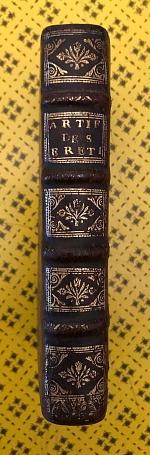
Rapin, Rene: Les Artifices des Heretiques. Paris: Chez Sebastien Mabre-Cramoisy. 1681. 12mo. pp. [xii], 444. Woodcut vignette to title. Small clean tear from outer edge of p.271, few leaves a trifle browned or dampstained. Contemporary sprinkled calf, raised bands, spine triple gilt ruled, gilt fleurons and tendrils, all edges sprinkled red. Boards and outer edges rubbed. A rather vigorous Jesuit diatribe against Jansenism as an heretical imposture, listing the 24 psychological techniques and social behaviours by which Jansenists pass themselves off as 'saintly people'. Ref: 53164show full image..
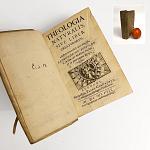
Raymond of Sebunde Theologia Naturalis sive liber creaturarum. Lugduni [Lyon]: Sumptibus Petri Compagnon, via Mercatoria, sun signo Cordis boni, 1648. 8vo., pp. 8, 678, [xxvi] Engraved printers device to title-page, woodcut head- and tail-pieces and initials, final two leaves are Approbationes Doctorum and Privilege du Roy Occasional very light spotting, faint ink smudges to a few margins. Contemporary semi-limp vellum, title inked to spine, rear ties remaining but others mostly lost. Shelfmark in an old hand to title-page verso. Vellum quite greyed with a few stains and smudges but still very good overall. Written 1434-1436 but not published until 1484, Theologia Naturalis was a landmark text in the history of natural theology. Originally composed in Catalan-influenced Latin, later followers composed a more classical version. In 1569 a Latin Translation by Michel de Montaigne was published in Paris. His 'Apology for Raymond de Sebonde' (Essays, book ii chapter xii) tells the story of his translation. Ref: 54766show full image..
Rowlands, Henry: [Owen, Henry, ed.:] Mona Antiqua Restaurata. An Archaeological Discourse on the Antiquities, Natural and Historical, of the Isle of Anglesey, the Antient Seat of the British Druids. In two essays. With an appendix, containing a Comparative Table of Primitive Words, and the Derivatives of them in several of the Tongues of Europe; with Remarks upon them.Together with some Letters, and three Catalogues, added thereunto. I. Of the M London: printed for J.[ohn] Knox, near Southampton-Street in the Strand, 1766. Second edition, corrected and improved. 4to., pp. xi, [v], 357, [iii] + 12 plates + 1 map frontispiece. With errata leaf and publisher's catalogue at rear. The plate of a king is here numbered XI, as found in some copies. Occasional annotations to margins in an old hand, corrections neatly inserted by hand. Occasional light foxing, some very slight transfer from plates to facing pages. Contemporary mottled calf, rebacked with original gilt spine and label retained, corners and fore-edge neatly repaired, marbled endpapers, very good. Recent bookplate of David W. Phillipson to front paste-down. To initial blank, inscription of C.H. Cooper F.S.A. (1808-1866), Town Clark of Cambridge from 1849 until his death. The second edition of Rowland's (1655-1723) work, in which he hypothesises that Anglesey was an ancient Druidic centre and that Britain was initially established by the Phoenicians. The first edition was published in Dublin in 1723. Rowland had died in the year of first publication, and so it was left to Henry Owen (1716-1795) to correct and revise this second edition (London, 1766). An edition of supplementary topographical details overseen by Nicholas Owen (1752-1811) appeared in 1775. ESTC T139796 Ref: 54388show full image..
Rowlands, Henry: [Owen, Henry, ed.:] Mona Antiqua Restaurata. An Archaeological Discourse on the Antiquities, Natural and Historical, of the Isle of Anglesey, the Antient Seat of the British Druids. In two essays. With an appendix, containing a Comparative Table of Primitive Words, and the Derivatives of them in several of the Tongues of Europe; with Remarks upon them.Together with some Letters, and three Catalogues, added thereunto. I. Of the M London: printed for J.[ohn] Knox, near Southampton-Street in the Strand, 1766. Second edition. 4to., pp. xi, [v], 357, [iii] + map frontispiece + 12 plates. Final leaf has a publisher's advert and errata. A few slight smudges and some faint pencil marks to margins but generally very clean. Contemporary tan speckled calf. Spine gilt with raised bands and red title label, small gilt crest to centre of each board. Joints worn with some areas of cords exposed, chip at tail of spine, corners frayed, very good. The second edition of Rowland's (1655-1723) work, in which he hypothesises that Anglesey was an ancient Druidic centre and that Britain was initially established by the Phoenicians. The first edition was published in Dublin in 1723. Rowland had died in the year of first publication, and so it was left to Henry Owen (1716-1795) to correct and revise this second edition (London, 1766). An edition of supplementary topographical details overseen by Nicholas Owen (1752-1811) appeared in 1775. From the ESTC: 'In some copies the plates are numbered I-IX and XI-XIII but they are the same 12 plates. Thus in some copies the plate of a king is numbered X and in others it is numbered XI. This may be an error in plate numbering which was later corrected or possibly there was an intention to insert an extra plate "X".' In this copy, the plate of a king is numbered XI. ESTC T139796 Ref: 55048show full image..
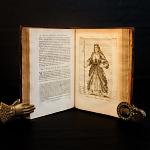
[Rowlands, Richard, pseud:] Verstegan, Richard: Restitution of Decayed Intelligence in Antiquities, Concerning the most Noble and Renowned English Nation. By the Study and Travel of R.V. London: John Bill, printer to the King's most Excellent Majestie, 1628. Second edition, first printed in England. 4to., pp.[xxiv], 338, [xii]. Title-page in red and black with large engraved vignette, woodcut initials head- and tail-pieces, many handsome illustrations in the text. Neatly pencilled bibliographical notes to ffep, few marginal notes in an older hand. Title-page a little foxed, occasional light ink blots and some spotting, a few pages with some light smudgy marks, eg. p.99. Trimmed a little close at head edge but never touching text. Later pale tan calf (probably late 19th c.), red and green labels to spine with date at foot wrongly put as 1828, blind tooled borders, edges coloured yellow, endpapers renewed. Headcap worn with small loss, some scuffs, joints worn with upper beginning to split at head, corners worn, frame of toning around free endpapers, still very good. To front paste-down the armorial bookplate of Hugh Robert Hughes of Kinmel, H.M. Lieutenant of Flintshire, obscuring a second bookplate beneath. Hughes (1827-1911), an avid collector of books and manuscripts on welsh history, topography and genealogy, purchased the collections of John Williams (1833-1872) of Beaumaris and Angharad Llwyd (1780-1866) of Caerwys (and later of Tyn-y-Rhyl), so the concealed bookplate may belong to one of these earlier collectors. Also to the paste-down is a small library label with shelf mark, and an ownership inscription of Brent Grafton-Maxfield dated 1972. An important work of early Anglo-Saxon scholarship originally published in Antwerp in 1605. Richard Rowlands (1548/50 ? 1640), English-born Anglo-Dutch writer and intelligence informant, was forced to flee England in 1581 having secretly printed Thomas Alfield's account of the execution of Edmund Campion. It was during this time that he revived his ancestral surname of Verstegan. 'From March 1587 Verstegan lived in Antwerp. From 1590 until 1603 he worked as a publishing and intelligence agent for the superiors of the English mission, William Allen in Rome and Robert Persons in Spain. He maintained communications between them and the missionaries in England, arranged passports and the smuggling of books, bought books in Flanders for the seminaries in Spain, and oversaw the printing of numerous English Catholic works in Antwerp. He continued to write polemical and martyrological works, including, most importantly, answers to the 1591 proclamation against Jesuits and seminary priests. He also produced devotional translations (among them the first English translation of the Tridentine primer), religious verse, and a seminal work of Anglo-Saxon scholarship, the Restitution of Decayed Intelligence in Antiquities (1605), about which he corresponded with Sir Robert Cotton. He edited or contributed to several of the political works generally attributed to Robert Persons. His writings in these years were a cause of great concern to the authorities in England, and did much to shape the perception of Queen Elizabeth's policies on the continent.' (Arblaster, ODNB). ESTC S116256 Ref: 54568show full image..
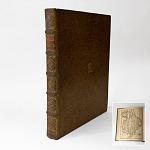
Roy, William: The Military Antiquities of the Romans in the North of Britain. [...]. Published by the Order, and at the Expense, of the Society of Antiquaries of London. London: printed by W. Bulmer and Co. and sold at the apartments of the Society, in Somerset-Place; a 1793. Large folio (540 x 365mm), pp. [x]xvi, 206, [ii] + 51, plates as called for. The three final leaves contain a list of plates and a list of members of the Society of Antiquaries. Occasional spots of foxing. Contemporary chestnut brown diced calf, rebacked with gilt title and rules, gilt borders, edges yellow, blue marbled endpapers. Spine scuffed, a few chips to edges, corners repaired, inner hinges repaired with cloth. A very good, sound copy Bookplate to front pastedown of Charles Abbott (1761-1817), a lawyer and botanist whose name appears in the list of Society of Antiquaries members found within. To preliminary blank, 'Fred. Swan, Trin. Coll. Cambridge, 1907'. Loosely inserted, a single printed leaf advertising Sir David Wilkie's 'Sketches in Turkey, Syria and Egypt'. Secondary title-page: [...] Particularly Their Ancient System of Castramentation, Illustrated From Vestiges of the Camps of Agricola Existing There: Hence His March From South Into North Is In Some Degree Traced. Roy's systematic studies yielded the first accurate maps of Roman archeological sites in Scotland. In the case of sites where the Roman remains were later destroyed by human development, these drawings are now the only reliable record of their former existence. Roy's innovation and leadership led to the creation of the Ordnance Survey in 1791, one year after his death, and two years later the Society of Antiquaries published this, 'a fine work which precisely described sites that in many cases are no longer visible; its map was finally superseded only with the Ordnance Survey's map of Roman Britain of 1924' (ODNB). ESTC T105077 Ref: 55034show full image..