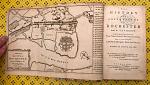
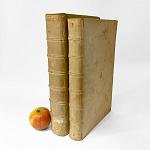
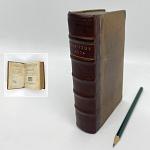
Shrubsole, William & Denne, Samuel; Fisher, Thomas, ed. The History and Antiquities of Rochester and its environs: To which is added a Description of the Towns, Villages, Gentlemen's Seats, and Ancient Buildings [...]. Rochester: Printed and sold by T. Fisher, 1772. First edition. 8vo. pp. [xiv], 353, [1]. With 1 folding map and 5 plates, few small illustrations. Small clean tear to lower blank margin of one leaf, title and verso of last a bit dusty, last few leaves somewhat foxed. Modern quarter calf over marbled boards, spine gilt, gilt-lettered label to spine. Stamp of Woods, Forests & Lands Revenue to title. First edition of this beautifully illustrated history of Rochester. William Shrubsole (1729?1797) was an English nonconformist minister, author of works on subjects as varied as local history, theology and even the Sheerness dockyards, where he was employed. The present work discusses the history of Rochester from the 11th century, lingering on its most important monuments. It was finished by the antiquary Samuel Denne, with the assistance of Thomas Fisher, printer, bookseller and alderman of Rochester. The initial folding map, with a plan of the city, also marks the ruins of the fire of 1768. ESTC T63426. Ref: 53275show full image..
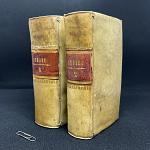
Silius Italicus: (Lemaire, Nicolaus Eligius, ed.:) Punicorum libri septemdecim. Parisiis [Paris]: Colligebat Nicolaus Eligius Lemaire. 1823. 2 vols., 8vo., pp.xiii, [i], 688; viii, 678. Complete in 2 vols., text and apparatus in Latin. Occasional spots of foxing, very good. Contemporary half vellum, gilt spines with red title and volume labels, marbled boards, edges and endpapers. Binding not quite identical to Propertius [54771] but very much in the same spirit. Spines slightly greyed, chips to label edges and a bit of loss to vol. I label, very good. Volumes in the "Bibliotheca Classica Latina sive Collectio Auctorum Classicorum Latinorum cum Notis et Indicibus". 'In directing our notice to the voluminous but judiciously selected compilation of Lemaire, we cannot forbear bestowing upon it a hearty tribute of eulogy.... We may safely pronounce it a performance in every respect creditable to both the spirit, learning, and perseverance of the individuals in immediate connexion with it, and also to the genius and reputation of the nation at large. The editions of the different Roman authors selected, are those of the most approved classical scholars in France, Germany, and Holland. The type is in the very best mould of the widely celebrated Didot Press' (North American Review, July 1834). The project was almost entirely finished at the time of that review, with just the Lucretius (published 1838) still to come. Ref: 54770show full image..
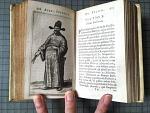
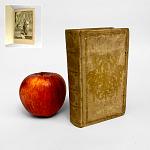
Solerius Cemeliensis, Anselmus, pseud. [Raynaud, Th?ophile]; (Frisius, Andreas Wilhelmus, ed.): Bosso, Girolamo: De pileo c?terisque capitis tegminibus tam sacris, qu?m profanis. Editio novissima aucta, emendata & figuris ?neis exornata; [bound with] De toga romana commentarivs, Accedit ex Philippo Rvbenio iconismus statuae togatae, et praeter indicem geminum, quem adjecimus, De modo gestandi togam ex Ferrario dissertatio. Amstelodami [Amseterdam]: sumptibus Andre? Frisii, 1671; 1671. 2 works bound as 1, often found together. 12mo., pp. [xii], 379, [xli] + 4 plates, including 3 folding; 84, [xii] + 1 folding plate. De Pileo with engraved title-page and second title-page with vignette (both part of first gathering), many engraved illustrations several of which occupy a full page, with final blank leaf. Very slightly toned but clean, short repaired tear to De Toga Romana's folding plate at gutter. Contemporary vellum, title inked to spine, edges sprinkled red. A few marks and smudges, corners very mildly rubbed, a very good copy indeed. Solerius' De Pileo is a curious work on hats and headgear, pseudonymously published by the French Jesuit theologian Th?ophile Raynaud (1583-1663). Amongst the numerous illustrations, the engraved title-page is signed by Romeyn de Hooghe; one folded plate is signed by Cornelis Galle. This 'new edition' of 1671 followed its original publication in Leiden in 1655. Here, it is found paired with the second edition of Girolamo Bosso's work on Roman secular and clerical togas, which made its first appearance in Pavia in 1614. Lipperheide 1650; Barbier III 700 & Lipperheide 220; Colas 399 Ref: 52285show full image..
Spence, Joseph: Polymetis: or an Enquiry concerning the Agreement between the Works of the Roman Poets and the Remains of the Ancient Artists. Being an Attempt to illustrate them mutually from one another. London: Printed for R. and J. Dodsley 1747. Folio, pp.xii, 361, [i] + portrait frontispiece + 41 plates (of which 2 double page and two double page and folding). Further engraved illustrations in the text. Toning transferred from the frontispiece image to the title-page, foxing and some blotchy toning, a few short closed tears to lower margins. Contemporary mottled brown calf, raised bands, spine lightly gilt, red morocco title label, edges sprinkled red. Both endcaps plus tail endband lost, upper joint cracked at each end but holding firm, corners frayed, repaired scrape to upper board, endpapers toned, rubbed but very good overall. To front pastedown, recent bookplate of Robert J. Hayhurst, and small shelfmark label. First edition of Spence's (1699?1768) interesting book on the connections between ancient artists and poets. The "long gestated Polymetis was published as a lavishly illustrated folio in February 1747 and earned him at least ?1450 by subscription and sale of copyright. Conceived during Spence's first visit to Italy and with much of its material collected there, Polymetis was intended to show how the works of ancient artists and of Roman poets illustrate and explain one another. It was attacked in Gotthold Ephraim Lessing's Laokoon (1766) and, though new editions appeared in 1755 and 1774, and abridged versions for the use of schools were current until the 1820s, it sank fairly quickly from serious notice. However, it proved an invaluable guide to mythological images for Keats." (ODNB). Polymetis is, in common with several of Spence's other works, written in dialogue form as he thought that the first person singular seemed arrogant. ESTC T133753 Ref: 55035show full image..
Statius, Publius Papinius: Sylvarum Libri V; Thebaidos Libri XII; Achilleidos Libri II. [Bound with:] Orthographia et flexus dictrionum Graecarum omnium apud Statius cum accentib. et generib. ex variis utriusque linguae authoribus. Parisiis [Paris]: apud Simonem Colin?um, 1530 8vo., ff. [ii], 263, [i]; [36]. Woodcut printer's device to title-page. Also contains the unpaginated "Orthographia et Flexus Dictionum Graecarum" at rear, with its own title and register. Title-page foxed with small abraded area (not affecting text), some sporadic light foxing but very good. Old semi-limp vellum, very plain, edges slightly overlapped. A couple of small stains, some smudgy marks, very good indeed. To front paste-down, engraved bookplate 'Biblioth?que de Mr Beaupr?, Conseiller ? la Cour de Nancy' of Jean-Nicolas Beaupr? (c.1792-1869), a magistrate and antiquary. To ffep, ownership inscription of Henry M. (Simmons?) in a fairly old hand. Very faintly to title page, ownership inscription with the first name Paulus dated 1649, surname sadly illegible. A reprint of the 1519 Aldine edition, together with the 'Orthographia', an etymological dictionary of the Greek words in Statius. The two were first printed together in 1502 (the first Aldine edition of Statius and the first edition of the 'Orthographia') but are otherwise not found together in any of the early editions. Described by Dibdin as 'an elegant and very accurate edition, worthy of the reputation of Colinseus'. BM STC French (1470-1600), 408; Adams, S1673; Schweiger II, pt.ii, 963; Dibdin II (4th edn.), 226. Ref: 54596
[Stephen of Byzantium] Stephanus Byzantinus: (Pinedo, T. de, ed.:) (Gronovius, J.F.:) [AND] [Holstein] Holstenius, Lucas: De Urbibus quem primus Thomas de Pinedo Lusitanus Latii jure donabat, & Observationibus Scrutinio Variarum Linguarum, ac praecipue Hebraice, Phaeniciae, Graecae & Latinae detectis illustrabat, his additae praeter ejusdem Stephani fragmentum collationes Jacobi Amstelodami [Amsterdam]: Typis Jacobi de Jonge; Lugd. Batavorum [Leiden] :Apud Jacobum Hackium, 1678; 1684. First edition thus. 2 works in 2 vols.. Folio, pp.[xx], 800, 84; [xvi], 497, [xxxv]. First vol.: with engraved emblem plate of a porcupine accompanying a motto on envy; engraved vignette to tile-page, woodcut initials and head- and tail-pieces; a little light sporadic toning, 5L2 and 5L3 a little toned with tiny hole affecting a couple of letters. Second vol.: title-page in red and black with printer's device; woodcut initials and head-pieces; half-title a little foxed and dusty; 2T slightly blotchy; 3V has been misbrand in the middle of 3X. Uniformly bound in blind tooled vellum, raised bands, embossed centrepieces, edges sprinkled red. Ties lost, some smudgy or dusty grey marks, very good indeed. Library bookplate with coat of arms to front paste down and small paper labels with shelf marks to head and tail of spines. Embossed coat of arms to head of both title-pages. The first work is the first printing of Pinedo's edition of Stephen of Byzantium, with Latin translation and commentary; the most scholarly to its date. Pinedo, a native of Portugal, dedicated his work to Don Gaspar de Mendoza. Pinedo's notes include studies of Hebrew and Phoenician as well as Greek and Latin words. Included is an edition, with new notes and commentary, of the Seguier library manuscript of Stephen, still considered the best; and the first printing of a collation made by Gronovius (1611-1671) with a manuscript from Perugia. A full index of words and matters is included at the end. This encyclopaedic etymology of the world's known places, written by the sixth century grammarian Stephen, is in fact lost in its original form, and the text that we have is an epitome possibly by a scholar called Hermolaus. Stephen dedicated his work to the Emperor Justinian, possibly Justinian I. Here uniformly bound as a made-up set with Lucas Holstein's volume of notes, which also contains: "Francisci Guieti Notae in Stephanum de urbibus, Xylandrianae editionis marginibus ab eo adscriptae" p. 365-372; "Scymni Chii Fragmenta [Periegeseos] (Romanised) hactenus non edita cum versione Latina Lucae Holstenii" p. [373]-383; "Theodori Ryckii Dissertatio de primis Italiae colonis et Aeneae adventu. Accedit ejusdem Oratio de Gigantibus" p. [393]-484. First work: Graesse VI, 1, 492; Hoffmann III, 441; Schweiger I, 300; Brunet V, 531. Ref: 55050show full image..
Strabo: (Veronese, Guarino; Tifernate, Gregorio, trans.:) [...] De Situ Orbis [?] De Situ Orbis Libri XVII. Editi quidem in eorum gratiam, qui geographi? studiosi sunt [?] Amstelodami [Amsterdam]: Joannem Janssonium Juniorem, 1652. 2 vols., pp.[xii], 809, [i], 41, [I]; 670, [ii], [xxiv] + folding map. Additional engraved title-page to vol.I, title-page with small woodcut to each volume, woodcut initials and headpieces. Vol.II with intermittent light dampstaining. Contemporary vellum, later reddish-orange gilt labels to spines, fore-edges slightly overlapped, edges sprinkled blue. Both spines a bit marked near the head, vellum a little yellowed, vol.I label neatly repaired, very good. Early Latin translations (first printed in 1469) of Guarino, who translated the first ten books, and Trifernas, who translated the remainder, of Strabo, one of the authors least frequently printed in his own Greek during the Renaissance. Dibdin II, 432-3. Adams S 1905. Ref: 54187show full image..
Suetonius, Caius Tranquillus: [van Oudendorp, Frans, ed.:] [XII Caesares] Ad Optimorum Exemplarium Fidem Castigatus. Leyden [Leiden], S. and J. Luchtmans, 1767. 12mo., pp. [iv], 408 + additional engraved title-page. Publisher's device to title-page, woodcut head- and tail-pieces. A few faint in lines to margins, occasional light ink smudges. Contemporary vellum prize binding, gilt spine, large gilt centrepiece of Middelburg to each board, edges sprinkled red. Vellum greyed with some smudgy marks, ties lost, very good. Scarce in UK institutions. Edited, according to Engelmann in his Bibliotheca Scriptorum Classicorum, by Frans van Oudendorp (1696-1761) professor of Eloquence and History at Leiden and 'the last of the great Latinists of the third age of scholarship in the Netherlands' (Sandys). Schweiger, 980; Spoelder 5. Ref: 54730show full image..
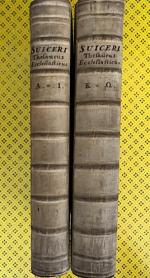
[Suicer] Suicerus, Johann Caspar: Thesaurus Ecclesiasticus, e Patribus Graecis ordine alphabetico [...] Editio secunda, priori emendatior, elegantior & longe auctior [?] Amstelaedami [Amsterdam]: Apud J. Henricum Wetstenium & Gul. Smith, 1728. 2 vols., folio, pp. [8], cols. 1476; pp. [iv], cols. 1654, pp. [68]. Main text printed in double columns. Vol. I has engraved frontispiece ('G.F.L. Debrie inv. Cl. Duflos fecit 1728'), title-page in red and black (vol.I) with engraved printer's device with motto: 'Terar dum prosim' (both vols.). Engraved head-piece to Dedication ('G.F.L. Debrie inv. et del. F. Morellon La Care sculpsit 1728') incorporating coat of arms of Sir Richard Ellys (1688-1742), the dedicatee, with motto: 'Aperto vivere voto'. Woodcut initials. With half-titles (in vol. I, bound after the title-page). Occasional light toning, a few ink smudges to vol.II. Contemporary blind-stamped Dutch vellum, title inked to spine, sprinkled edges. Vellum a little grubby, small area of turn-in lifting inside the upper board of vol.II, very good. Ink inscription to ffep of vol.I: 'John Duke Coleridge, from his loving Father & Mother, for his birthday, Dec. 3, 1860, with their prayers for his health & happiness'. Inscription 'J.D. Coleridge' to vol. II. Small leather label with 'D.C.D.' and a cockerel crest in gilt to each front paste down, with some transfer to the ffep. Small bookseller's label to front pastedown vol. I, 'Sold by C.J. Stewart, 11 King William Street, W. Strand, London.' The second edition of this important resource for the study of Greek patristics, first printed in 1682 (and with a further edition following in 1746). Johann Kaspar Suicer (1620-84) was a Swiss reformed theologian and a philologist. John Duke Coleridge (1820-1894) English lawyer, judge and politician, was great-nephew of the poet Samuel Taylor Coleridge, who had owned a copy (now in the British Library) and said of it: "Unfortunately I have none of the Greek Fathers?neither have I the Septuagint?but I have found much that I want, in Suicerus's Thesaurus Patrum, which I was lucky enough to buy for it's [sic] weight at a Druggist's?" (letter to John Prior Estlin, 26 July 1802). Graesse VI (pt.I) 525; Brunet V 586. Ref: 54206show full image..
Tacitus, Caius(?) Cornelius: (Lipsius, Justus, ed.:) Historiarum et annalium libri qui exstant, Iusti Lipsii studio emendati & illustrati: [?] eiusdem Taciti liber de moribus Germanorum. Iulii Agricol? vita. Incerti scriptoris dialogus de oratoribus sui temporis. [?]. Antuerpi? [Antwerp]: ex officina Christophori Plantini, 1574. First Lipsius edition. 8vo., pp. 762, [xxi]. Title-page with woodcut Plantin device, woodcut initals, rear blank Bb8 and final gathering *8 ('Index Alphabeticus in Cornelium Tacitum') both present, two colophons (one dated 1574 and the other 1575). Very faint toning, some small darker patches to title and final leaf near gutters, trimmed a little close to printed marginalia but only just touching a few letters. Much later plain paper-covered boards recently rebacked in brown calf with gilt Morocco title label, edges sprinkled red. Without free endpapers, a few scuffs and marks, corners lightly bumped, still very good. To front paste-down: modern blue ink ownership inscription of D.L. Cumming; printed booklabel (perhaps early 20th century) of William Reynolds of Streatham. 'Tacitus is the outstanding historian and the principal prose writer of the Silver Age of Latin letters? Relatively unknown during the Middle Ages, Tacitus, whose works were first printed in Venice about 1473 and several times reprinted before the end of the century, exercised great influence on Renaissance historians. Justus Lipsius (1547-1606), the Netherlands scholar, knew the whole of Tactitus by heart, and his great edition (here cited), nineteen times reprinted, is one of the monuments of sixteenth century scholarship. In a life much vexed by the violence of governments, he found much, as his notes declare, in common with Tacitus's ironic and cynical records of first-century Rome.' (PMM) Adams T31; BM STC Dutch Books S. 195; Dibdin II, 450; PMM 93; Schweiger II, pt.ii, 999; Voet 2276. Ref: 54137show full image..