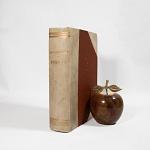
Nelson, E. Charles & Elliott. David J. (eds.): The Curious Mister Catesby: A "Truly Ingenious" Naturalist Explores New Worlds. Athens & London: The University of Georgia Press, 2015. First edition. Large format (287mm x 212mm), pp. xx, 424. Illustrations throughout. Hardback: brown cloth, gilt-lettered to spine. Small bumps to top corners, otherwise very good. Dust-jacket, two small tears to spine, otherwise very good. Edited for the Catesby Commemorative Trust by F. Charles Nelson and David J. Elliott. Foreword by Jane O. Waring. Ref: 54818
Nepos, Cornelius: Excellentium Imperatorum Vitae. Londini [London]: Jacobi Tonson & Johannis Watts, 1735. 12mo., pp. [xii], 114, [vi]. Engraved frontispiece by Du Gernier, title-page in red and black with woodcut device, ornamental headpieces and initials. Internally very clean, some pencil to endpapers. Contemporary tan calf with raised bands and spine label, spine and edges a bit rubbed, upper joint just starting at head but still very sound. Much like the 1715 edition (the title verso is printed with a licence dated 1714 which grants exclusive rights for printing and publishing for 14 years), though reset to be slightly larger, and with different ornaments used. ESTC T83008 Ref: 54212show full image..
Nepos, Cornelius: Vitae Excellentium Imperatorum, [observationibus & notis commentatorum omnium quotquot hactenus innotu?re illustratae. Accesserunt huic editioni praecipuorum Graeciae imperatorum icones aeri incisae; ut & index rerum & verborum auctior & emendatior.] [Amstelodami [Amsterdam]: Prostant apud Jansonio-Waesbergios, Boom, & Goethals, 1705.] 1704 8vo., pp.[xxx], 439, [xli]. With the additional engraved title-page but lacking the typographical titlepage. Illustrations in the text. Slightly foxed, sporadic toning. Vellum prize binding with certificate dated 1708 bound in. Gilt spine, borders, cornerpieces, and large centrepiece to each board with the arms of Amsterdam, edges sprinkled brown and red. A few smudgy marks, upper board gilt a little worn, ties lost, very good. Prize certificate made out to Nicolao Doekscheer and signed by Johannes Theodorus Schalbruch, Professor of Logic, History and Oratory (1697-1722) (at Amsterdam). To the additional engraved title page: 'Cornelii Nepotis Vitae excellentium imperatorum cum quorundam iconibus', with imprint "Amstelodami. Ex sumptibus Societatis. MDCCIV". Spoelder 9. Ref: 54918show full image..
Nepos, Cornelius: (Pausanias:) (Fell, John, ed.:) Excellentium imperatorum vitae. Editio novissima; nunc denuo recognita. Accessit Aristomenis Messenii vita, ex Pausania. Oxonii [Oxford]. E Teatro Sheldoniano. 1708. 4to. pp. [xx], 230; [ii], 38, [xviii], [lvi]. Engraved frontispiece, engraved vignette to title, engraved ornaments at start of each chapter. Little spotting to title and verso of last leaf. Early 19th century Russia leather, marbled endpapers, triple gilt ruled, raised bands, spine double gilt ruled and gilt-lettered, cross-hatched decoration in blind. Covers a bit faded, joints cracked but firm. Bookplate of Robert J. Hayhurst to front pastedown. Reprint of the 1678 Oxford edition of Cornelius Nepos's 'Lives of the Emperors', in a remarkably and unusually well-preserved Russia leather binding. ESTC T83009. Ref: 53167show full image..
Nepos, Cornelius: (Van Staveren, Augustinus, ed:) Vitae Excellentium Imperatorum, cum notis selectis Boecleri, Bosii, Buchneri, Ernstii, Gerhardi, Heidmanni, Lambini, Loccenii, Longolii, Magii, Ravii, Savaronis, Schefferi, Schotti, nec non excerptis P. Danielis. Hisce accedit locupletissimus omnium vocabulorum index studio & opera Lugduni Batavorum [Leiden]: Apud Sam. et Joan. Luchtmans, 1773 [1774]. 2nd ed., expanded. 8vo., pp.[32], 832, [176]. Additional engraved title-page dated 1774, woodcut initials, head- and tail-pieces, engraved illustrations in the text (portraits). A few pencil marks, eg. p.117. Contemporary vellum prize binding, gilt spine, borders, corner tools and centrepiece coat of arms of Utrecht to each board, edges sprinkled red and blue. A few light marks, ties lost, very good. Includes: C. Nepotis fragmenta [?] A. Schotti studio collecta, scholiisque illustrata [?] recensita [?] et [?] aucta a J.A. Bosio, cujus [?] animadversiones Schottisnis interseruntur, Curante A. van Staveren. With index at rear. Dibdin II, p246 for this, the better of two Staveren editions (1734 and 1773); Schweiger II pt.i, 302. Ref: 54555show full image..
Neville-Rolfe, Eustace: Pompeii Popular and Practical. An Easy Book on a Difficult Subject. Naples: Emil Prass, 1899. Third edition, revised and corrected. 8vo.,pp. vi, [ii], 308, [iv] + folding map at rear. Illustrated with card-mounted views of Pompeii artefacts etc, including frontispiece. Very light toning toward edges. Half vellum, terracotta cloth-covered boards, gilt title to spine, top edge red, patterned endpapers. Spine a little greyed, a few smudgy marks, very good. Tiny label to front pastedown, Emilio Prass, Napoli. Neville-Rolfe wrote this guide to Pompeii while British Consul General in Naples. Ref: 55256show full image..
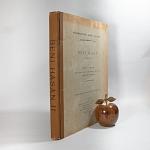
Newberry, Percy E.: Fraser, G. Willoughby (illust.): Beni Hasan: Part II London: published under the auspices of the Egypt Exploration Fund. Sold by Kegan Paul, Trench Trubn 1893. Folio, pp. viii, 85, [i] + 37 consecutively numbered plates, including frontispiece, + plates VIIIA and XXIIA, giving a total of 39. Some plates in colour, some folding. Further tables and illustrations in the text. Loosely inserted, a printed sheet 'The Egyptian Alphabet, with the Current Methods of Transliteration'. Clean and bright within. Publisher's binding, tan cloth spine with title in black, grey paper boards, the upper printed with title etc. Cover paper quite toned, edges worn, several dents to upper board. A very good, sound copy. To ffep, ownership inscription of Olive L. Ager, 1964. From the Editor's Preface: 'The present volume completes the description of the tombs at Beni Hasan. To this detailed description has been added the report of the Surveyor, Mr Willoughby Fraser, who deals with the plans and measurements of the whole series of tombs and with the objects found in the course of his excavations. The summary accounts contained in the "General Notice" in Part I are also continued and completed; the sections printed in this volume deal with the decoration of the tombs, with the history of the families concerned, and with the geography and the religion as illustrated in the scenes and inscriptions; the situation of the tombs, their purpose, date, and architecture, having been already discussed in Part I.' Part of the Archaeological Survey of Egypt, edited by F.L. Griffith. Ref: 54792show full image..
Newcourt, Richard: Repertorium Ecclesiasticum Parochiale Londinense: An Ecclesiastical Parochial History of the Diocese of London: Containing an Account of the Bishops of that Sea, from the first Foundation thereof: also, of the deans, archdeacons, dignitaries and prebendaries, from the Conquest: and lastly, of the se London: printed by Benj. Motte, and are to be sold by Chr. Bateman, Benj. Tooke, Ric. Parker, 1708; 1710. 2 vols., folio, pp.[iv], vii, [I], 761, 764-5, 768-9, 772-3, 776-928, [ii] (i.e. usual mispagination) + 4 plates; [viii], 692, [lii] + 2 plates. Vol. I with portrait frontispiece and errata leaf, vol. II with half-title and list of subscribers, as called for. Sporadic toning, vol. II heavily toned from p.609 onwards and with a small worm trail near gutter for approx. first hundred pages. MS to ffep vol. I (a description in heraldic terminology of the arms of Richard Newport depicted on the frontispiece). Contemporary Cambridge panelled calf, raised bands and reddish title labels to spines, edges sprinkled red. A bit worn with some scrapes, but very good. Each volume with armorial bookplates of John Hoadly, LLD to front paste-down and Henry Carrington Bowles to rear paste-down (the latter being the Bowles arms with those of H.C.B.'s wife Ann Garnault inset). Historian and notary Richard Newport (d.1716) complied this history of the Diocese of London from sources including the London Registers (begun in 1306), registers kept by individual bishops and a return of 1636 from which he took information about the income of the parishes. His father (also Richard Newcourt, d. 1679) was a cartographer and draughtsman who, in addition to contributing drawings to Dugdale's Monasticon, was also responsible for the most important map made of London before the Great Fire, his Exact Delineation of the Cities of London and Westminster and the Suburbs Thereof (1658). John Hoadly (1711-1776) was a poet and dramatist, and a friend and correspondent of David Garrick. The appearance of 'LLD' on his bookplate dates it from sometime after 1747. Henry Carrington Bowles (1763-1830) was a successful publisher and seller of maps, prints and geographical games. His bookplate dates from sometime after his marriage in 1799. The ephemera found between the pages of vol. I appears to relate to his ownership of the book. Loosely inserted: two letterpress-printed sheets reproducing letters sent in January 1824 and February 1827 to The Gentleman's Magazine, concerning London churches destroyed in the Great Fire of 1666 (both from 'H.C.B.'); small hand-drawn and coloured arms of Sir John Philpot, Lord Mayor of London 1378, on a scrap of paper; a piece of tracing paper with a coat of arms and an inscription referring to Sarah Bolles; 4 scraps of paper with MS notes, one seemingly part of a letter addressed to H.C. Bowles Esq. and dated 1827; a long MS list of churches on a folded piece of paper watermarked 1821. ESTC T5439; Upcott 690; Lowndes 1665; Graesse IV 662. Ref: 54146show full image..
Newport, Kenneth G. C. Apocalypse & Millennium: Studies in Biblical Exegesis. Cambridge University Press, 2000. First edition. 8vo., pp. x, 252. Hardback: black cloth, silver-lettered to spine. Dust-jacket. Unused and, with just a hint of shelf-wear, almost as new. Ref: 53752
Nicolaidis, Etfthymios (Emanuel, Susan, trans.): Science and Eastern Orthodoxy: From the Greek Fathers to the Age of Globalization. Baltimore, The Johns Hopkins University Press, 2011. First edition. 8vo., pp. xx, 252 + plates. Hardback: black cloth, gilt-lettered to spine. Dust-jacket. Unused, a hint only of shelf-dust: a fine copy. Ref: 55268