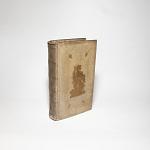
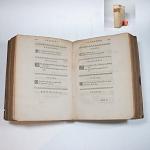
[(Gale, Thomas, ed.:)] Opuscula Mythologica. Physica et Ethica. Gr?ce et latine. Seriem eorum sistit pagina pr?fationem proxime sequens. Amstelaedami [Amsterdam]: Apud Henricum Wetstenium, 1688. 8vo., pp.[xxx], 7-752, [viii]. Additional engraved title-page, printed title-page in red and black, woodcut initials and head- and tail-pieces. Occasional tiny marginal notes, some fore-edges unopened. Top of head margin very faintly toned. Vellum prize binding, spine gilt, gilt centrepiece of arms of Leiden to each board, edges sprinkled red. Spine a little grey, some smudgy marks, centrepiece stamped to front board so emphatically it has gone through the vellum in a few spots, silk ties lost except one, which is tucked into the rear endpapers, pastedowns lifted and a little creased, still very good. The better second edition, revised and expanded from the 1671 first, of Thomas Gale's most important collection of fragments and small works by classical authors including Eratosthenes, Heraclitus, Heraclides, Theocritus, and Timaeus, with facing Latin translations. Brunet IV, 198 ("Bonne ?dition"); Graesse V, 31; Schweiger I, 133 & 221. Ref: 55094show full image..
Gellius, Aulus: Noctes Atticae. Editio nova et prioribus omnibus doctis hominis cura multo castigatior. Amstelodami [Amsterdam]: apud Ludovicum Elzevirium, 1651. Editio Nova. 12mo. [48], 498, [124]. Small clean tear to lower blank margin of F10, another three on K12, V3-4 touching text. Contemporary vellum over boards, yapp edges, title inked to spine (modern), all edges sprinkled blue. Spine little rubbed. Ex-libris of Rudolph Apfelbeck 1883 to ffep. 'The first two editions from the Elzevir press [of which this is the first] were carefully published by J.F. Gronovius.' (Dibdin) 'Fort jolie et qui passe pour tres correcte' (Willems) Dibdin I, 340; Pokel, 101; Schweiger II, 378; Willems, 1127. Ref: 53177show full image..
Gratius (or Grattius) Faliscus: (Wase, Christopher, trans.:) Cynegeticon. Or, A Poem of Hunting by Gratius the Faliscian. Englished and illustrated by Christopher Wase Gent [...]. (London:) Charles Adams, 1654. 12mo., pp. [xciv], 86. Latin text and English translation on facing pages, the latter verso. Some light dust soiling, heavier on title and verso of last leaf, browning mostly to margins and occasional spots. 19th century half calf over marbled boards, gilt-lettered morocco label. Joints and extremities rubbed, small repair at head and foot. 20th century inscription to front pastedown, later monogram RC inked to title. The first edition in English of this poem on hunting by a contemporary of Virgil and Ovid. The translator's commentary includes chapters on "the styles of hunting different from the English, both antique and forreigne" and "the modern authors who have written upon this subject." The first edition in Latin had been published in Lyon by Sebastian Gryphius in 1537. For an account of Wase's translation (which remained the only English-language translation of Gratius' poem for 280 years until the Loeb Library edition, with translation by J. W. Duff and A. M. Duff, in 1934,)see the chapter 'Hunting and the seventeenth-century English gentleman' by Michael Waters in Steven J. Green (ed.), Gratius. Hunting an Augustan Poet (Oxford University Press, 2018), pp. 235-256. Wing G1581; ESTC R1966; Schwerdt I, p.217. Ref: 53093show full image..
[Gregorius (Gregory) XIII] Corpus iuris canonici emendatum et notis illustratum. Gregorii XIII. pont. max. jussu editum indicibus variis et novis, et appendice Pauli Lancellotti, Perusini adauctum [...] His postrema hac editione accesserunt constitutiones nou? PP. SS. qu? VII. Decretalium loco iure merit? esse possint: illustrati Lugduni [Leiden]: [s.n.], 1622. 6 vols. bound as 1. 4to., pp.[lxiv], cols.1272, pp.[xx], cols.754, pp.[xiii], cols.406, pp.[ix], cols. 158, pp.[lxxxiii], cols.278, pp.[xiii]. Title-page in red and black with large woodcut printer's device. Woodcut initials, ornamental head- and tail-pieces. A little toned, small spots and smudges, occasional paper flaws to bottom edge. A very small amount of marginalia in an old hand. Somewhat later vellum, neatly rebacked with old spine retained, very lightly blind embossed centrepiece, edges red, endpapers renewed. A few spine splits repaired, upper joint just starting at head but holding firm, a few smudgy marks but very good indeed. Contents: Vol.I. Decretum Gratiani; Vol.II. Decretales D. Gregorij Pap? IX; Vol.III. Liber sextus Decretalium D. Bonifacij Pap? IIX vn? cum Clementinis & extrauagantibus; Vol. IV. Index generalis pr?cedentium librorum; Vol.V. Institutiones iuris canonici, ? Paulo Lancellotto, Perusino conscript?; Vol.VI. Liber septimus Decretalium, cum indice. See Camus 2686, which lists the first edition as having been published in Rome (1582). Ref: 54923show full image..
Gronovius, Johannes Fredericus: Observatorum in Scriptoribus Ecclesiasticis, [...], Monobiblos. (with) Observationum Liber Nonus, [...] Notis ad T. Livium [...]. Daventriae [Deventer]: typis Johannis Columbii, 1651; 1652. Two works in one vol. 8vo., pp. [xxvi], 292, [xxviii]; [xxiv], 431, [lxiii]. Printer's device to both title-pages, woodcut initials and decorative headpieces. A few leaves unopened at fore-edge. Occasional small spots (wax?) and smudges, very good. Contemporary vellum, titles inked to spine, fore-edges slightly overlapped, all edges blue. Pencilled booksellers' notes to front pastedown. A few marks to boards, endpapers toned, an approx. 3cm piece cut out of ffep possibly to remove a name, still very good. Two ownership inscriptions to ffep: D. Wyttenbach, dated August 1765, and J.A. Jeremie(?) dated 1863. The former is quite likely to be the classical scholar Daniel Wyttenbach (1746-1820), student of Hemsterhuis, Valckenaer and Ruhnken who, along with them, laid the foundations for modern Greek scholarship. In 1765 he was just ending his studies at the university in Marburg. Johannes Fredericus Gronovius (1611-1671) was in 1643 appointed professor of rhetoric and history at Deventer, before moving in 1658 to the Greek chair at Leiden, where he spent the rest of his life. Gronovius was the 6th Librarian of the University of Leiden (1665?1671) and, in a nice link, Wyttenbach became the 13th Librarian in 1799 following the death of David Ruhken. Wyttenbach also wrote a highly-regarded Life of his predecessor, which was published in Leiden in the same year. Ref: 54418show full image..
Grotius, Hugo (trans., ed.): Excerpta ex tragoediis et comoediis Gr?cis tum qu? exstant, tum quae perierunt emendata et Latinis versibus reddita ab Hugone Grotio. Cum notis & indice auctorum ac rerum. Parisiis [Paris]: Apud Nicolaum Buon, in via Iacob?a, sub signis S. Claudij & Hominis Siluestris, 1626. 4to., pp.[xii], 1006, [xxxviii]. Greek and Latin texts on facing pages, 3 page errata and colophn at rear. Title-page in red and black, woodcut initials and endpieces. Light dampstaining at gutter and to title-page and first few gatherings, ink spot to very edge of fore-edge margin towards rear, some lower margins a little short with deckle edges, A2 and A3 a bit crumpled with short tear to fore-edge margin, 6P4 with quite large loss to fore-edge margin but not affecting text. Plain contemporary vellum, some worn ms and remains of a label to spine. Vellum a little rumpled, some grey smudgy marks, endcaps worn, a few chips and stains, a good sound copy. 4 initials (?) in an old hand to title-page. A compilation of excerpts of Greek plays translated into Latin verse, which was written, like most of Grotius' (1583-1645) major works, during his exile in Paris. He had been imprisoned in Loevestein Castle because of his involvement in several controversies over the religious policy of the Dutch Republic but escaped in 1621, aided by his wife and maidservant who concealed him inside a book chest. He fled first to Gorinchem and then to Paris, where he received a royal pension and stayed almost continuously until 1644. This volume appeared the year after his most famous work, De Jure Belli ac Pacis (1625), widely regarded as a foundational text in the development of international law. BM STC French,1601-1700, T766; Ter Meulen/Diermanse 468. Ref: 55232show full image..
Harwood, Edward: A View of the Various Editions of the Greek and Roman Classics, with Remarks [...] London: printed for T. Becket [...] 1775. First edition. 8vo., pp. [ii], xxiv, 229, [iii]. Includes three-page catalogue of Harwood's books sold by Becket at rear. Some reversed writing in light pencil to p.96, seemingly offset from something no longer present. A few lightly smudges to title-page but generally clean internally. Mid-twentieth century half tan calf, gilt spine with label, brown marbled boards, edges sprinkled red. A bit rubbed, joints slightly worn but firm, small dent to top edge of upper board, still a very good copy. Pencil note to front paste-down: 'Coll. Christopher Dobson c.1967'. 'Harwood (1729?1794) was a prolific writer and author of numerous religious and biblical treatises and classical works. He once claimed to have written more books than anyone then living with the exception of Joseph Priestley. Of these the one which contributed most to his reputation as a scholar was A View of the Various Editions of the Greek and Roman Classics (1775), which by 1790 had run to four editions and had been translated into German (1778) and Italian (1780 and 1793).' (ODNB) ESTC T118350 Ref: 51811show full image..
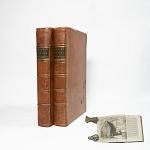
Hearne, Thomas: A Collection of Curious Discourses Written by Eminent Antiquaries Upon Several Heads in our English Antiquities. Together with Mr Thomas Hearne's Preface and Appendix to the Former Edition, to which are added a great number of Antiquary Discourses written by the same authors, most of them now First Published from the Original Manuscripts. London: printed for Benjamin White, 1775. 2 vols., pp.[xiv], LXXI, [i], 354; [vi], 449, [xv] + folding plate, bound opposite p.XLV rather than as a frontispiece as often found. Full page illustration at h4. Gathering A accidentally repeated. A little foxed, some small patches of toning and light dusty marks, 2Q1 and 2Q2 a little short at fore-edge built not affecting text, Index a bit toned. Contemporary tan calf, raised bands gilt ruled, green morocco title labels, edges sprinkled red. Joints creased and just starting at ends, rubbed, corner frayed, vol.II with small losses to endcaps, endpapers foxed, very good overall. A reissue of the edition of 1771 with cancel title-pages. Originally published in 1720, one of a flurry of publications that came after Hearne's attempted prosecution by the University of Oxford over his preface to Camden's Annals which 'appeared to damage the University, and seemed to imply Catholic inclinations' (ONDB). ESTC T132033 Ref: 55144show full image..
Herbert, Edward (Lord Herbert of Cherbury): The Life and Reign of King Henry the Eighth. London: printed by M[ary] Clark, for Henry Herringman [?]. 1682. Folio, pp. [vi], 636, [xx] + portrait frontispiece. Title-page in red and black, woodcut initials, final leaf blank. 4G with short closed tear to lower margin not affecting text, a few light spots and smudges. Contemporary brown calf, spine label replaced, raised bands, blind-tooled borders and frames. Head- and tail-caps repaired, rubbed, joints creased and a bit worn, corners repaired, some spots and stains but still very good. Ownership inscription of Ja. Winstanley in an old hand to top of title-page. Third edition (the first published in 1649) of this apologetic Life of Henry VIII by the soldier, statesman and Deist philosopher Edward Herbert (1572-1648), elder brother of the poet George Herbert. ESTC R37413 Ref: 54896show full image..
[Historiae Augustae] (Casaubon, Isaac, ed.:) Histori? August? Scriptores Sex. Aelius Spartianus, Julius Capitolinus, Aelius Lampridius, Vulcatius Gallicanus, Trebellius Pollio et Flavius Vopiscus [...]. Parisiis [Paris]: Apud Amberosium & Hieronymum Drouart, [...] cum privilegio Regis, 1603. First edition thus. 2 parts in 1 vol., 4to., pp. [xx], 375, [lvii]; 576, [xxxvi]. Illustrations in text. Title-page to first part in red and black, to second part in black only, woodcut initials and head- and tail-pieces, with final errata leaf. Top corner of title-page a little frayed, first leaf of text with 2-line note in blue biro to head margin, head margins a bit dusty with very occasional light dampstains, occasional spots of foxing, a few paper flaws to fore-edge margins. Small scorch marks to pp.47-8 and pp.101-4 affecting a few letters, smudgy mark (ink or wax?) to fore-edge margin pp.115-22, ink spots to p.345. Contemporary semi-limp vellum, fore-edges slightly overlapped. Quite browned, covers somewhat creased, ties lost, turn-ins lifting, without ffep but still good and sound overall. Latin inscription in an old hand to title-page translates roughly as 'from the common library of the preachers of Dijon'. First appearance of Casaubon's edition of this collection of biographies of the emperors from Hadrian to Carinus, considered to be the first critical edition and also the first to use the title Histori? August?. (The title as recorded on the 9th-century Codex Palatinus manuscript of the Vatican Library is Vitae Diversorum Principum et Tyrannorum a Divo Hadriano usque ad Numerianum Diversis compositae, and it is generally thought that the work may have been originally known as de Vita Caesarum or Vitae Caesarum.) In early editions 'the emphasis had been laid on the Latin text, but in the seventeenth century the work of the editors included not only textual emendation, but comment and illustration. Of these editions the first was that of Casaubon, published in 1603. It was not unnatural that these biographies should have attracted the editor of Suetonius and Polybius and the scholar who wrote in the preface to his edition of the Historia Augusta that "political philosophy may be learned from history, and ethical from biography."' (from David Magie's introduction to his 1921 Loeb edition.) Though its authenticity was regarded with a little scepticism, Casaubon's edition was for hundreds of years used as a genuine source by historians (including Edward Gibbon in the first volume of his Decline and Fall of the Roman Empire). Browning sums up the tricky position the work occupies: "in modern times most scholars read the work as a piece of deliberate mystification written much later than its purported date, however the fundamentalist view still has distinguished support. [?] The Historia Augusta is also, unfortunately, the principal Latin source for a century of Roman history. The historian must make use of it, but only with extreme circumspection and caution." ('Biography', in The Cambridge History of Classical Literature: Volume 2 (1983).) Graesse III, 303; Sandys II, 209; Schweiger II, 384. Ref: 54541show full image..