[Horace] Horatius Flaccus, Quintus: (Bentley, Richard, ed.:) [Opera] ex recensione & cum notis atque emendationibus Richardi Bentleii. Editio altera. Amstelaedami [Amsterdam]: Apud Rod. & Gerh. Wetstenios Hff. 1713. 4to., pp. [xxiv] 717, [i], 239, [i], including engraved additional title-page and divisional title for 'Pars altera' after p.442. Emendata after p.717 (i.e. 4Y1 verso). Index at rear. Title page in red and black with engraved device, woodcut initials. Gatherings 3M-3O and 3V-3X very toned, occasional light toning otherwise, a few tiny scorchmarks. Contemporary marbled calf, spine gilt with red morocco label, gilt borders, lovely blue paste-patterned edges, very good. With letterpress and manuscript school-prize (to J.J. van Hees, dated 1822) bound at the front. The second edition of Bentley's (in)famous edition of Horace, first printed at Cambridge in 1711, notable for his rash but inspired conjectures and emendations. "The Amsterdam editions of 1713 and 1728 are preferable to the Cambridge one of 1711. The notes and text are in the same page, and they are accompanied by the index of Treter, corrected by Verburgius" (Dibdin 104). Dibdin (4th edn.) II 101; Schweiger II 406; Bijker Riedel A140; Lowndes 1113: "The best edition."; Graesse III 354 (note); Brunet III 319 (note). Ref: 54397show full image..
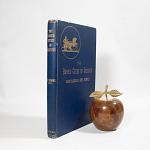
Horne, John Fletcher: The Buried Cities of Vesuvius; Herculaneum and Pompeii. London: Hazell, Watson, and Viney, 1895. 8vo., pp. vi, [ii], 113, [iii] + frontispiece and 5 further plates. A few very light smudges to title page, tissue guard to frontispiece toned. Blue publisher's cloth, gilt titles to spine, gilt title and small image of a chariot to upper board, dark blue endpapers. Endcaps worn and joints a little rubbed, some scratches to endpapers, very good. Newspaper clipping from the Sunday Times dated 8th March 1998 loosely inserted. Ref: 55252show full image..
Horsley, John: Britannia Romana: or the Roman Antiquities of Britain: In Three Books. The I. Contains... Roman Transactions... II.... the Roman Inscriptions and Sculptures... III. Contains the Roman Geography of Britain. London: Printed for John Osborn and Thomas Longman. 1732. Folio, pp. [viii], xxxii, 520, [xl] +105 plates, some folding. Half-title, engraved head-pieces. A few smudges and dust marks and generally very clean. Later diced tan calf, spine gilt and blind tooled, raised bands, gilt and blind-tooled borders, all edges gilt, gilt dentelles, drab endpapers. Joints cracked, the upper also chipped and repaired with dark cloth. Rubbed, endcaps worn some small surface losses, lower corners frayed, inner hinges repaired with tape, some pencilled bookseller's notes to ffep, externally a bit tired but still very good overall. 'Horsley had been collecting material on the history of Roman Britain when, about 1727, he began working on them with a view to publication. He was assisted in various aspects of his antiquarian research by his friend and correspondent Robert Cay, and by George Mark, who was probably Horsley's assistant at his school in Morpeth. Mark helped to prepare the plans and drawings for Horsley's history, undertook archaeological tours and explorations, and made surveys, including one of Watling Street. He was also assisted by John Ward, professor of rhetoric at Gresham College, who helped revise the manuscript 'and communicated to him many important remarks for its improvement' (Nichols, Lit. anecdotes, 5.521). Horsley's work on Hadrian's Wall utilized material from Alexander Gordon's Itinerarium septentrionale (1726), though his reliance on this book largely went unacknowledged. The Britannia Romana, or, The Roman Antiquities of Britain was divided into three 'books'. The first contained the history of the Romans in Britain, with accounts of the legions stationed there, the Roman stations, and a substantial description of the Roman walls; the second 'book' contained a complete collection of the Roman inscriptions and sculptures found in Britain, together with historical and critical notes; the third 'book' contained a 'Roman geography of Britain', including all the extant ancient Roman accounts of Britain. Horsley wrote that the first 'book' had cost him: 'much labour and time in my study, to draw out an history of transactions, through so many ages, and at such a distance from our own times ? But I need not inform the world, that the second book was the most expensive and tedious. Several thousand miles were travelled on this account, to visit antient monuments ? I omitted no care nor pains, that was necessary to copy these with the greatest exactness, which was the principal design of the work.' (Horsley, Britannia Romana, 1732, i). The book's prefatory dedication to Sir Richard Ellys was written on 2 January 1732, but Horsley did not live to see the publication in early April of this, his greatest achievement. On 12 January he was, according to his friend Ward, 'suddenly and unexpectedly taken off by an apoplexy' (Hinde, 178). His exertions on his Roman history were thought to have contributed to his early death at the age of only forty-six [...] Despite occasional inevitable errors and inaccuracies, Horsley's Britannia Romana was one of the major antiquarian achievements of his day. F. Haverfield in The Roman Occupation of Britain (1924) described it as 'till quite lately the best and most scholarly account of any Roman province that had been written anywhere in Europe' (Haverfield, 75).' (ODNB) ESTC T115200; Upcott xii. Ref: 55067show full image..
Houellebecq, Michel: (Stein, Lorin, trans.:) Submission. London: William Heinemann, 2015. First edition, first printing. 8vo., pp.[iv], 251, [i]. White cloth, black title to spine, publisher's device blindstamped to upper board, fine. Dustjacket a little dusty, price intact, fine. Translated by Lorin Stein. Ref: 54680
Hourihane, Colum (ed.): Byzantine Art: Recent Studies. Essays in Honor of Lois Drewer. Tempe: Arizona Center for Medieval and Renaissance Studies, 2009. 8vo., pp. 197. Hardback: laminated boards. New: unopened in publisher's shrink-wrap. Ref: 53408
Howard, Robert: The History of the Reigns of Edward and Richard II. With reflections, and characters of their chief ministers and favourites. As also, a comparison between those Princes Edward and Richard the Second, with Edward the First, and Edward the Third. Written in the year 1685. London: printed by F. Collins, for Thomas Fox, at the Angel in Westminster-Hall, 1690. 8vo., pp.[vi], xvi, [i], 183, [i]. Occasional light spotting but very clean within. Contemporary dark brown speckled calf, gilt spine with title and raised bands, edges sprinkled blue and red. Old paper label to foot of spine, upper joint cracked but holding firmly, a little toning to endpapers, very good indeed. Later work by Sir Robert Howard (1626-1698), politician and playwright, published during a particularly consequential period in an already notoriously turbulent life. 'Under James II, Howard helped bring about the revolution that put William of Orange on the throne. He served in William's first parliament, contending in the Commons on 22nd January 1689 that James II had in effect 'abdicated the government' (Oliver, 256). Several years later Howard was to sign the 'association' of 1696, an agreement to defend William against the Jacobites. As in the past, Howard tried to strike a balance between his royalist sympathies and his belief in the rights of parliament. In February 1689 the king appointed him to the privy council, the crowning achievement of his political career. Howard's final years were taken up with both professional and literary concerns. Late in 1694 he helped Betterton and his actors to procure a licence for the new theatre at Lincoln's Inn Fields; and in 1695 he renewed his friendship with [his brother-in-law] John Dryden. Meanwhile, he had published his History of the Reigns of Edward and Richard II (1690), involving him in the ongoing controversy concerning the divine right of kings, and The History of Religion (1694), an anti-Catholic tract.' (Vander Motten, ODNB) ESTC R2296. Ref: 55085show full image..
Howell, William: An Institution of General History, from the beginning of the World to the Monarchy of Constantine the Great. Composed in such Method and manner as never yet was extant. London: Henry Herringman, 1661. First edition. Folio, pp.viii, 881, [iii]. Woodcut initials and headpieces; at rear, errata and two-page publisher's catalogue. Very lightly toned, occasional small mark or light ink blot. 2E with small piece lost at top corner, 2S closed tear to top corner, 3F3 a little short at fore-edge margin, none of which affecting text. Tiny scorch hole to 3S affecting a couple of letters. Contemporary calf neatly rebacked. Gilt spine, raised bands title label, plain blind-tooled borders, edges red. Scuffed, a few marks, corners worn, structural vellum flap visible between board and ffep, a few tiny codes and sums in various hands to endpapers, top corner of rear free endpaper lost, very good. To front pastedown, armorial bookplate of Sir Lister Holte, 5th Baronet (1720-1770). A landowner in Warwickshire and MP for Lichfield from 1741 to 1747, Holte was also High Sheriff of Cheshire. To head of title-page, ownership inscription of Robert Holt in an old hand. First edition of the major work of historian and civil lawyer William Howell (1631/2-1683), it was reissued the following year with a different title-page and a table added at the end. 'Howell was a substantial but under-appreciated historical writer of the Restoration, in the tradition of world history writing that included Sir Walter Ralegh's History of the World (1614), then the most popular work of its kind in English, but which ended before the birth of Christ. Howell's most widely read work, which clearly borrows from Ralegh, was An institution of general history ? from the beginning of the world till the monarchy of Constantine the Great. This first appeared in 1661 and then in several subsequent editions. He abridged it into Latin as Gulielmi Hoeli, LL.D. Elementa historiae for the use of Mulgrave and other young men in 1671 [...]. Howell had always intended to publish a second part of the Institution, covering western and eastern Christendom after Constantine, and refers to this second part in his Elementa. It was unpublished at Howell's death in 1683, but in 1685 his widow, Mary, had it published, complete with her own dedicatory epistle to James II. [?] Borrowing from Reformation chronological writing, Howell organized his book according to the principle of synchronism, making it easy for a reader following his account of one kingdom or empire to grasp contemporary events that occurred elsewhere. Howell'sInstitution was perhaps the most readily accessible history of the world published in the Restoration, appealing to a growing readership for comprehensive histories that provided a straightforward summary of events since the creation. [?] (Woolf, ODNB) ESTC R14308; Wing H3136. Ref: 55083show full image..
Hudson, T. P. (ed.): The Victoria History of the County of Sussex. Volume VI Part 1: Bramber Rape (southern part). Oxford University Press for the Institute of Historical Research, 1980. First edition. 4to. Fully illustrated. Hardback: red cloth, gilt, fine. Dust-jacket, price-clipped, faded in part with fraying edges but still good. Ref: 54076
Hudson, T. P. (ed.): The Victoria History of the County of Sussex. Volume VI Part 3: Bramber Rape (north-eastern part) including Crawley New Town. Oxford University Press for the Institute of Historical Research, 1987. First edition. 4to. Fully illustrated. Hardback: red cloth, gilt, fine. Dust-jacket, price-clipped, a little creased and discoloured over spine with fading to lettering, otherwise very good. Ref: 54078
Hughes, Ian: Attila the Hun: Arch-Enemy of Rome. Barnsley: Pen & Sword, 2019. First edition. 8vo., pp. xxvi, 214. Maps and illustrations to text. Hardback: grey cloth, gilt-lettered to spine. Dust-jacket. Unused, a hint only of shelf-dust: a fine copy. Ref: 54451