Raphael, Frederic: A Jew Among Romans: The Life and Legacy of Flavius Josephus. New York: Pantheon Books, 2013. First edition, first impression. 8vo., pp. xxvi [ii], 3-336. Black cloth-backed red boards, silver-lettered to spine. Cream dust-jacket, light shelf-wear and dust-marks. Remainder mark to bottom edge. Otherwise as new. Ref: 55300
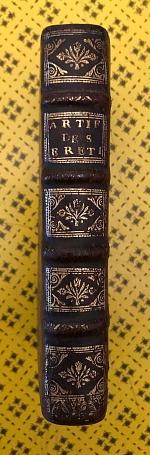
Rapin, Rene: Les Artifices des Heretiques. Paris: Chez Sebastien Mabre-Cramoisy. 1681. 12mo. pp. [xii], 444. Woodcut vignette to title. Small clean tear from outer edge of p.271, few leaves a trifle browned or dampstained. Contemporary sprinkled calf, raised bands, spine triple gilt ruled, gilt fleurons and tendrils, all edges sprinkled red. Boards and outer edges rubbed. A rather vigorous Jesuit diatribe against Jansenism as an heretical imposture, listing the 24 psychological techniques and social behaviours by which Jansenists pass themselves off as 'saintly people'. Ref: 53164show full image..
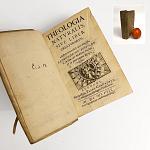
Raymond of Sebunde Theologia Naturalis sive liber creaturarum. Lugduni [Lyon]: Sumptibus Petri Compagnon, via Mercatoria, sun signo Cordis boni, 1648. 8vo., pp. 8, 678, [xxvi] Engraved printers device to title-page, woodcut head- and tail-pieces and initials, final two leaves are Approbationes Doctorum and Privilege du Roy Occasional very light spotting, faint ink smudges to a few margins. Contemporary semi-limp vellum, title inked to spine, rear ties remaining but others mostly lost. Shelfmark in an old hand to title-page verso. Vellum quite greyed with a few stains and smudges but still very good overall. Written 1434-1436 but not published until 1484, Theologia Naturalis was a landmark text in the history of natural theology. Originally composed in Catalan-influenced Latin, later followers composed a more classical version. In 1569 a Latin Translation by Michel de Montaigne was published in Paris. His 'Apology for Raymond de Sebonde' (Essays, book ii chapter xii) tells the story of his translation. Ref: 54766show full image..
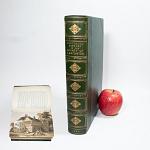
[Redding, Cyrus:] The Pictorial History of the County of Lancaster: with one hundred and seventy illustrations and a map. London: George Routledge, 1844. 4to., pp. [vi], 238 [i.e.338], xlii, (pp. [ii], 11, [i] + 5 lithographed plates), xliii-xlviii. Map of Lancashire at rear. Some plates a bit foxed, occasional neat pencil notes and marks. 20th-century half green morocco, gilt spine, raised bands, green cloth boards, green marbled endpapers. Pencilled notes to preliminary blank. Bands a little rubbed, some light wear to lower board edges, very good indeed. Recent bookplate of Robert J. Hayhurst to front pastedown. Exuberantly extra illustrated with 35 bound-in plates (one of which appears to be a small painting), including frontispiece, in addition to the in-text engravings listed at the front. One further plate pasted onto the final page. Additional images include portraits, views, grand houses etc, plus a separate work, 'Profiles of Warrington Worthies' by James Kendrick, 1853, found just before the index. Cyrus Redding (1785-1870) was a journalist who had, in 1842, published the same text with How & Parsons as part of a large series, which included a similar work on Cornwall also written by Redding. Remaining sheets and/or blocks were presumably bought by Routledge, who published this volume two years later. Ref: 55055show full image..
Rees, Owen: Great Naval Battles of the Ancient Greek World. Barnsley: Pen & Sword, 2018. First edition. 8vo., pp. xxii, 218 + plates. Maps and illustrations. Hardback: grey cloth, blue-lettered to spine. Dust-jacket. Unused, a hint only of shelf-dust: a fine copy. Ref: 54499
Reyerson, Kathryn L.: Mother and Sons, Inc. Martha de Cabanis in Medieval Montpellier. Philadelphia: University of Pennsylvania Press, 2018. First edition. 8vo., pp. viii, 255. Illustrations to text. Hardback: beige cloth, blue-lettered to spine. Dust-jacket. Unused, a hint only of shelf-dust: a fine copy. Ref: 54354
Reynolds, Jack: The Great Paternalist. Titus Salt and the Growth of Nineteenth-Century Bradford. London: Maurice Temple Smith in association with The University of Bradford, 1983. 8vo., pp. 382. Black cloth, silver lettering. Dustwrapper slightly creased. Very good. Ref: 51389
[Rhetores Graeci] Walz, Christianus, ed.: Rhetores graeci, ex codicibus florentinis, mediolanensibus, monacensibus, neapolitanis, parisiensibus, romanis, venetis, taurinensibus et vindobonensibus / emendatiores et auctiores edidit, suis aliorumque annotationibus instruxit, indices locupletissimos adiecit Chr Stuttgartiae et Tubingae Londini; Lutetiae: J.G. Cottae; Black, Young et Young; Firmin Didot, 1832-6 9 vols.. bound as 10 (vol. 7 in 2 parts). 8vo.. Text in Greek, introduction and notes in Latin. Vol. 1 foxed. Pinkish-purple cloth, simple gilt titles to spines, edges sprinkled red. Spines very much sunned and a little brittle with fading extending just over the joints. Vols. 4, 5 and 7 pt i with torn head caps, a few smudgy marks to boards, endpapers toned, still very good sound copies overall. Brunet IV, 1266. Ref: 54741show full image..
Roberts, Mike: Hannibal's Road: The Second Punic War in Italy 213-203 BC. Barnsley: Pen & Sword, 2017. First edition. 8vo., pp. xxv,262 + plates. Maps. Hardback: red cloth, silver-lettered to spine. Dust-jacket. Unused: as new. Ref: 54643
Roberts, Mike: Two Deaths at Amphipolis: Cleon vs Brasidas in the Peloponnesian War. Barnsley: Pen & Sword, 2015. First edition. 8vo., pp. xxiii, 264 + plates. Maps. Hardback: red cloth, gilt-lettered to spine. Dust-jacket. Unused, a hint only of shelf-dust: a fine copy. Ref: 54346