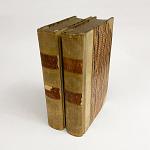
Selden, John: (Boxhorn, Marcus:) Mare Clausum seu de Dominio Maris. Libri Duo [?]. I. Mare, ex iure natur? seu gentium, omnium hominum non esse commune, sed dominii privati seu proprietatis capax, pariter ac tellurem, esse demonstratur: II. Serenissimum Magn? Brittani? regem maris circumflui, ut individu? atque perpetu? imperii bri Londini [London]: Juxta exemplar Will. Stanesbeii pro Richardo Meighen, 1636. Second edition. 12mo., pp. [xxiv], 504, 61, [iii]. Two parts bound together, chiefly in Latin, with passages in English, French, Greek, Hebrew and Arabic. Title-page in red and black, woodcut initials, several full-page illustrations (including 2 maps) and smaller numismatic illustrations in the text. Title-page with library ink stamp and the remains of a small paper label to top fore-edge corner, a few gatherings toned (e.g. K), some faint spots and smudges, a little light toning. Contemporary plain vellum, detailed titles inked to spine, edges faintly sprinkled brown. Vellum a little yellowed, spine greyed, a few small stains, a little surface damage to top corner of board near joint where a sticker has been mostly removed, top corner of ffep lost, still a very good, sound copy overall. To front pastedown, 'Heinbrychelii 1767', a few library codes. This edition came a year after the first, which appeared in folio in 1635. Selden (1584-1654) was commissioned by Charles I (pursuing a highly ambitious maritime policy) to undertake this work in order to settle disputes which had arisen between England and Holland over the rights Dutch fishermen claimed to fish in the waters surrounding the British Isles. It ranks as the classic opposition to the arguments made by Grotius, one of the Dutch emissaries, in his work 'Mare Liberum' (1609) that 'the sea was free to all'. Selden's response argued that the seas as well as land were capable of private dominion; he traces customs from the Greeks forward in support of his thesis. The result is a book "of tremendous erudition and replete with learning? fortified at every point with authority from record, statute, case-book and chronicle" (Fletcher: John Selden, Selden Society Lecture, 1969). ESTC S117048; Sabin 78972; Rahir 439; cf. Willems 449. Ref: 54922show full image..
Seneca, Lucius Annaeus ('the Elder') & Seneca, Marcus Annaeus: (Gronovius, J.F., et al. eds.:) Opera, quae exstant [...] Accedunt Liberti Fromondi in Quaestionum Naturalium libros & (Greek letters) APOKOLOKHNTWSIN notae et emendationes. Amstelodami [Amsterdam]: Apud Danielem Elsevirium, 1672. First edition thus. 3 vols., pp. [lviii], 869, [iii]; [iv], 998, [lxxxiv]; [xxiv], 750, [ii], 316, [xxviii]. Vol I with extra engraved frontispiece and further illustrations in text. Woodcut printer's device to title-pages with motto 'Ne extra oleas', woodcut initials, head- and tail-pieces. Marginal notes in several different old hands to the first two volumes. Head margins faintly toned, occasional light spotting and a bit of foxing to vol. III, vol. I with unobtrusive repair to final leaf. Contemporary vellum with titles very nicely inked to spines, fore-edges turned in, edges lightly sprinkled blue. Vellum a bit dusty, a few small marks, very good indeed. Vol. I has an illegible ownership inscription in an old hand to its ffep, and a second inscription (possibly reading 'W.W. Kosteri') to the title-page. According to Harwood "the most beautiful and correct edition of Seneca.". Dibdin considers it "one of the rarest and dearest of the octavo Variorum classics: its typographical beauty is equal to its editorial correctness. Scholars who possess it will do well to treasure so valuable and commodious a work." This Elzevier edition is unusual in presenting in its third volume the writings of the younger Seneca, which Dibdin notes are omitted in the Antwerp editions. It contains the best notes available: those of the first great modern Senecan, Justus Lipsius in the late sixteenthcentury, and those of the second great Seneca scholar, J. F. Gronovius. Daniel Elzevier's dedication, to Simon Arnauld, Marquis de Pomponne, covertly discusses the part which Elzevier played as printer for an orchestrated anti-Jesuit campaign. Willems 1477; Schweiger II, 913; Dibdin II 398-399. Ref: 54139show full image..
Seneca, Lucius Annaeus: (Farnaby, Thomas, ed:) Tragoediae, Ad Editionem Gronovii Emendatae. Cum notis Thomae Farnabii. Accedunt Hieronymus Avantius et Georgius Fabricus de Generibus Carminum, apud L. Anneum Senecam Tragicum. Amstelodami [Amsterdam]: Apud Janssonio-Waesbergios, 1713. 12mo., pp. [xxxvi], 371, including additional engraved title-page. Title-page in red and black with woodcut decoration, woodcut initials. Final leaf deliberately adhered to rear board in lieu of endpapers, internally very clean. Slightly later quarter calf, gilt spine with red Morocco label, blue marbled paper boards. Quite worn but sound, ffep (possibly as replacement, as it seems to have been tipped in) loose, spine and label chipped, corners frayed, good. A pleasant pocket edition of Farnaby's edition of Seneca, which had been first published in 1613. Schweiger II pt.ii, 941. Ref: 54635
[Seneca] Regenbogen, Otto: Schmerz und Tod in den Tragodien Senecas. Darmstadt: Wissenschaftliche Buchgesellschaft, 1963. 8vo., pp.56. Internally clean and bright. Red cloth, gilt title to spine. Spine lightly faded, a little shelf-wear, no dust-jacket, very good. Inscription of C.D.N. Costa dated 20.vi.'88 to ffep. Pain and Death in the Tragedies of Seneca. Ref: 52087
Severus, Sulpicius: Opera Omnia. quae extant. Amstelodami [Amsterdam]: Ex officina Elzeviriana, 1656. 12mo. 332pp., [4]. Engraved title, decorated initials and ornaments. Title and verso of last leaf dusty, one small marginal tear to title. Contemporary (Welsh?) sprinkled calf, blind ruled with arabesque cornerpieces in blind, raised bands. Joints a bit cracked but firm, covers little rubbed. Ex-libris of William Lhwyd to flyleaf. 'Re-imprint line by line of the edition produced by the Elzevirs of Leiden in 1643', 'very nice' (Willems 1207). Willems 1207. Ref: 53176show full image..
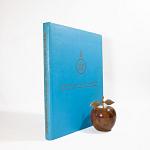
Sharp, Ralph Norman: The Inscriptions in Old Persian Cuneiform of the Achaemenian Emperors. [Tehran]: Published by the Central Council of the Celebration of the 25th Century of the Foundation n.d. [c.1964]. 4to., pp.183 + 15 plates including two in colour. Illustrations and numerous examples of cuneiform in the text. Very faintly toned towards top edge. Blue cloth, gilt title to spine and to upper board with gilt centrepiece. Tiny tear to cloth at head of spine, near fine. Loosely inserted, a stapled selection of photocopied leaves (mostly images and a bibliography) from two works by Ali Sami, both translated by Sharp: Pasargadae (1971) and Persepolis (1970). Rev. Sharp (1896-1995) was Assistant Professor of Old Persian and Pahlavi at the University of Shiraz. He obtained cuneiform type, which enabled the printing of the extant inscriptions in Old Persian of the Achaemenian Sovereigns, along with their translations into English, French and Persian. Sharp was the translator of three books by Ali Sami (Curator of Persepolis and Director of the Archaeological Department of the Province of Fars). Ref: 55102show full image..
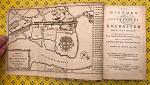
Shrubsole, William & Denne, Samuel; Fisher, Thomas, ed. The History and Antiquities of Rochester and its environs: To which is added a Description of the Towns, Villages, Gentlemen's Seats, and Ancient Buildings [...]. Rochester: Printed and sold by T. Fisher, 1772. First edition. 8vo. pp. [xiv], 353, [1]. With 1 folding map and 5 plates, few small illustrations. Small clean tear to lower blank margin of one leaf, title and verso of last a bit dusty, last few leaves somewhat foxed. Modern quarter calf over marbled boards, spine gilt, gilt-lettered label to spine. Stamp of Woods, Forests & Lands Revenue to title. First edition of this beautifully illustrated history of Rochester. William Shrubsole (1729?1797) was an English nonconformist minister, author of works on subjects as varied as local history, theology and even the Sheerness dockyards, where he was employed. The present work discusses the history of Rochester from the 11th century, lingering on its most important monuments. It was finished by the antiquary Samuel Denne, with the assistance of Thomas Fisher, printer, bookseller and alderman of Rochester. The initial folding map, with a plan of the city, also marks the ruins of the fire of 1768. ESTC T63426. Ref: 53275show full image..
Sidhu, Nicole Nolan: Indecent Exposure: Gender, Politics, and Obscene Comedy in Middle English Literature. Philadelphia: University of Pennsylvania Press, 2016. First edition. 8vo., pp. ix, 303. Illustrations to text. Hardback: dark-green cloth, gilt-lettered to spine. Light beige dust-jacket dust-marked in places, otherwise a fine, unused, copy. Ref: 54352
Sigerist, Henry E.: A History of Medicine. New York: Oxford University Press, 1955, 1961. 2 vols. First edition of second. 8vo. pp. [xxi], [1], 564; [xvi], 352, with illustrations, vol. 2 with illustrated frontispiece. Green cloth, boards of vol. 2 a bit sunned and spotted. Else very good copies. Second printing of vol. 1. Ref: 53426
Silius Italicus: (Lemaire, Nicolaus Eligius, ed.:) Punicorum libri septemdecim. Parisiis [Paris]: Colligebat Nicolaus Eligius Lemaire. 1823. 2 vols., 8vo., pp.xiii, [i], 688; viii, 678. Complete in 2 vols., text and apparatus in Latin. Occasional spots of foxing, very good. Contemporary half vellum, gilt spines with red title and volume labels, marbled boards, edges and endpapers. Binding not quite identical to Propertius [54771] but very much in the same spirit. Spines slightly greyed, chips to label edges and a bit of loss to vol. I label, very good. Volumes in the "Bibliotheca Classica Latina sive Collectio Auctorum Classicorum Latinorum cum Notis et Indicibus". 'In directing our notice to the voluminous but judiciously selected compilation of Lemaire, we cannot forbear bestowing upon it a hearty tribute of eulogy.... We may safely pronounce it a performance in every respect creditable to both the spirit, learning, and perseverance of the individuals in immediate connexion with it, and also to the genius and reputation of the nation at large. The editions of the different Roman authors selected, are those of the most approved classical scholars in France, Germany, and Holland. The type is in the very best mould of the widely celebrated Didot Press' (North American Review, July 1834). The project was almost entirely finished at the time of that review, with just the Lucretius (published 1838) still to come. Ref: 54770show full image..